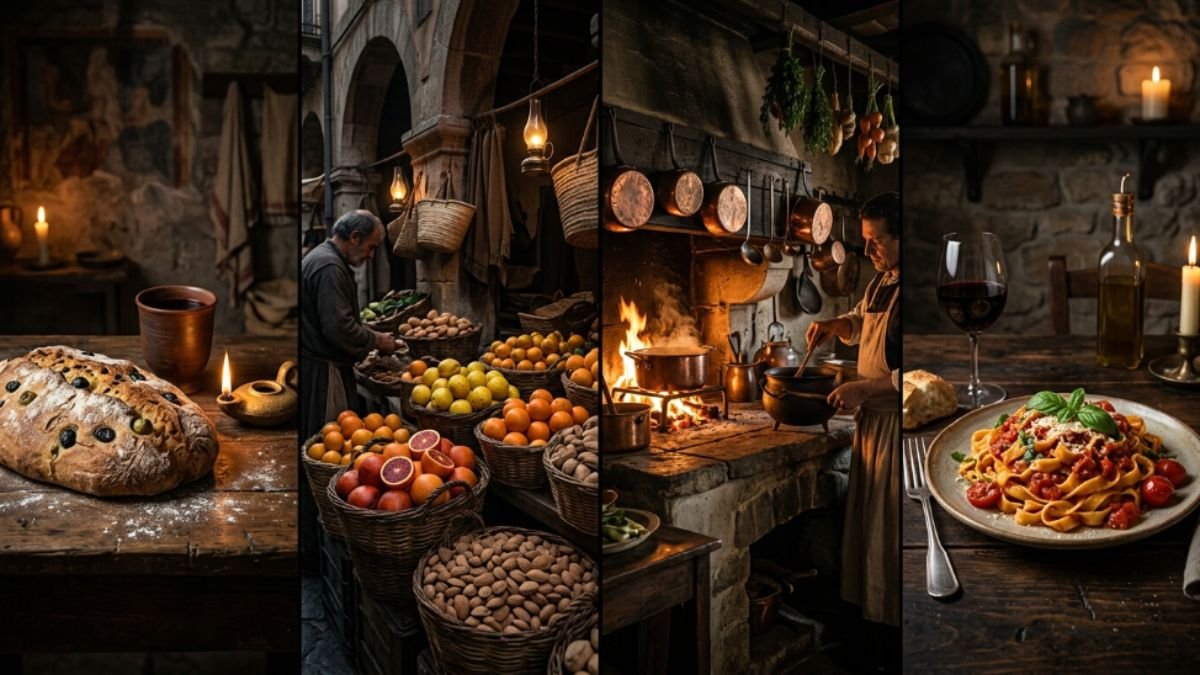
Italian Cuisine History: From Ancient Rome to the Modern Table
Italian cuisine history is not one story but a long layering of empires, migrations, and stubborn regional pride that took more than two thousand years to settle into the food the world now recognizes. Long before pizza, espresso, or a plate of carbonara existed, the people of the Italian peninsula were already arguing about ingredients, trading for spices across the Mediterranean, and treating the shared table as the center of daily life.
Knowing where these traditions came from changes how you cook, how you travel, and how you taste. The arc that follows runs from the bread and olives of the Roman Republic to the precise, region-proud kitchens of the present day, and it shows why so much of what feels timeless about Italian food is actually the result of constant reinvention.
The Roman Foundations of the Italian Table
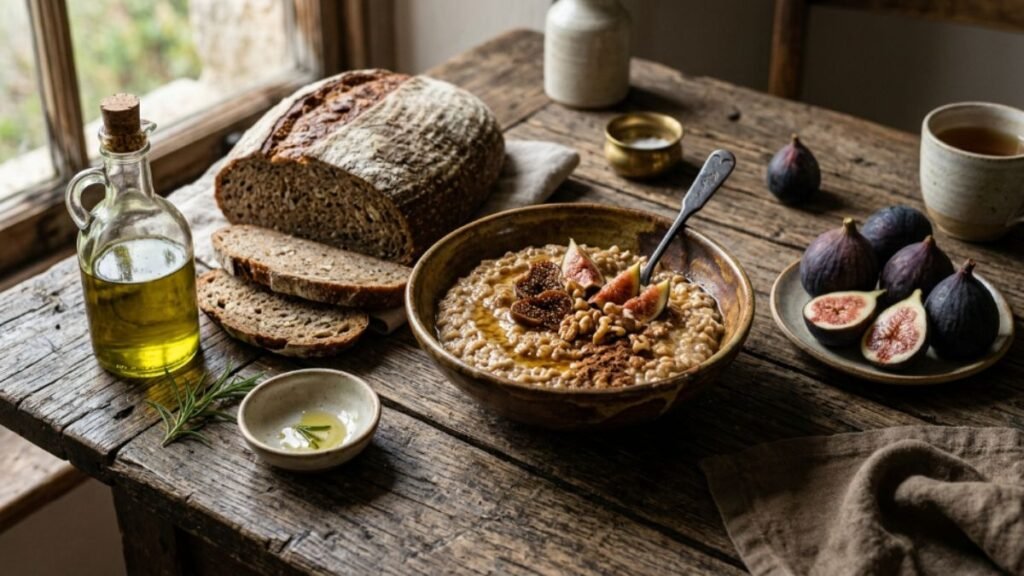
The deepest roots of Italian eating reach back to ancient Rome, where daily life turned on a simple agricultural triad: grain, the olive, and the vine. Wheat fed the population, olive oil lit lamps and dressed food, and wine accompanied nearly every meal.
This was less a cuisine of recipes than a cuisine of staples, shaped by what the land around the Mediterranean could reliably produce. The Romans built an entire economy and a network of roads partly to keep that grain and oil moving, and in doing so they spread a way of eating across an empire that stretched from North Africa to the edges of Britain.
What Romans Actually Ate
For most Romans, the everyday meal was puls, a thick porridge made from emmer wheat that predated bread itself. As milling improved, leavened bread became a marker of status, with the wealthy eating refined white loaves while laborers made do with coarser, darker versions.
Flavor came from honey, herbs, and above all garum, a pungent fermented fish sauce that Romans splashed onto nearly everything the way later cooks would reach for salt. The surviving recipe collection attributed to Apicius records elaborate banquet dishes for the elite, full of imported spices and theatrical presentation.
Two ingredients we now treat as the soul of Italian food were entirely absent from this table: the tomato, which had not yet crossed the Atlantic, and pasta in its familiar dried form. Roman cooking did include simple sheets of dough, but the dense, regional pasta culture of later centuries was still unimaginable. Readers who want to see how far Roman roots eventually traveled can trace one Lazio classic in our look at the story of a Roman pasta born from cured pork and eggs.
The Birth of a Mediterranean Pantry
What Rome truly established was a pantry. Olive oil, wine, wheat, legumes, cheese, and a handful of vegetables formed a flexible, plant-forward foundation that survived the empire itself. Centuries later, scholars and health organizations would describe this same pattern as the Mediterranean diet recognized as intangible cultural heritage, a living tradition rather than a modern invention. The olive in particular remained a cornerstone, and the way a single ingredient can anchor an entire regional identity is something we explore in our guide to what makes a true extra virgin olive oil.
The Middle Ages and the Arab Influence on Sicily
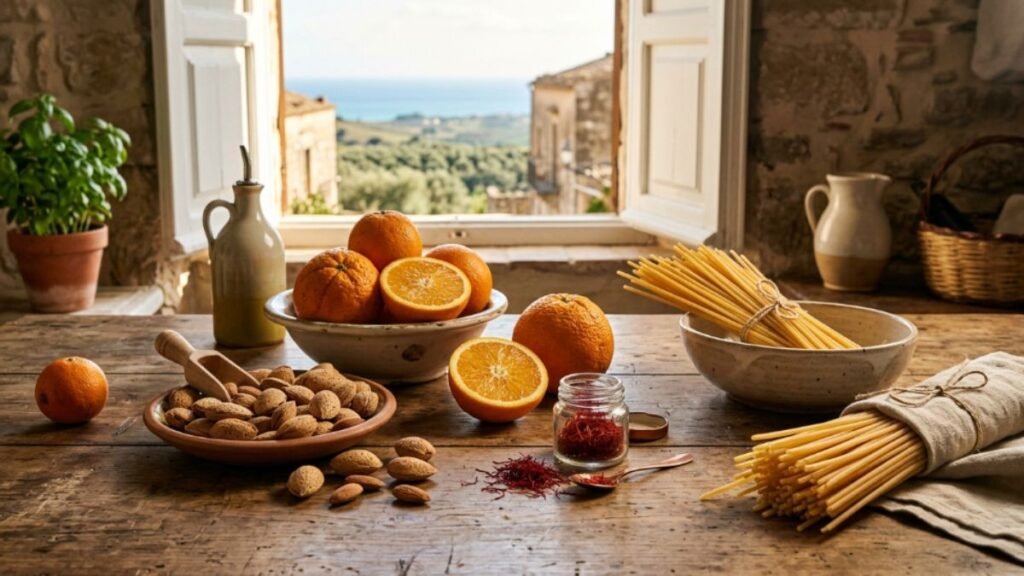
When the Western Roman Empire collapsed, the peninsula fractured into smaller territories, and the table fractured with it. The most transformative culinary chapter of the early medieval period unfolded not in Rome but in Sicily, which came under Arab rule from the ninth to the eleventh centuries. The new rulers brought an agricultural revolution with them: sugarcane, citrus fruits, rice, almonds, eggplant, spinach, and saffron all entered the island and, from there, slowly spread north. They also brought sophisticated irrigation and a taste for the sweet-and-sour combinations that still flavor Sicilian cooking today.
One of the most consequential introductions was hard durum wheat, which can be dried and stored for long periods. Medieval Sicily became an early center of dried-pasta production, and a twelfth-century account describes a thriving industry near Palermo exporting dried strands across the region. Dried pasta, in other words, was being made and traded in Italy long before it became a national symbol, and its origins owe as much to Arab Sicily as to any Roman kitchen.
Sugar, Citrus, and the Roots of Frozen Desserts
Sugarcane changed the sweet side of the Italian table as profoundly as durum wheat changed the savory side. Combined with snow carried down from the mountains and flavored with fruit, sugar gave rise to early iced desserts, the ancestors of granita and sorbetto that would eventually evolve into gelato. That lineage is the reason a dessert tradition feels so deeply Sicilian and so deeply Italian at once. Anyone tracing that evolution from medieval ices to the modern scoop will enjoy our overview of what sets Italian frozen desserts apart from the rest of Europe.
The Renaissance and the Rise of Regional Refinement
By the Renaissance, the peninsula was a patchwork of wealthy, competitive city-states, and each court treated its kitchen as an extension of its prestige. Florence, Ferrara, Naples, Venice, and the papal court in Rome cultivated cooks whose work was recorded in increasingly detailed manuals. Bartolomeo Scappi, chef to several popes, published an enormous illustrated work in 1570 that documented techniques, equipment, and hundreds of dishes with a precision that reads like a professional textbook. Cooking had become an art worth writing down.
This period explains a feature of Italian food that still confuses newcomers: there has never really been a single national cuisine. Political division meant that flavors, fats, and staples differed sharply from one territory to the next, with butter and rice dominating the north while olive oil and wheat ruled the south. That regional divergence was not a flaw to be corrected but the very structure of the tradition, and it persists in protected form to this day.
Catherine de Medici and a Persistent Myth
No discussion of Renaissance food escapes the legend of Catherine de Medici, the Florentine noblewoman who married into the French royal family in 1533. Popular retellings credit her and her entourage of cooks with civilizing French cuisine overnight, teaching the French everything from forks to fine pastry. Most food historians treat this as charming folklore rather than fact, since French cooking was already sophisticated and the evidence for a single revolutionary influence is thin. The story endures anyway, which is itself a useful lesson: culinary history is full of national myths that flatter one side and simplify a far messier reality.
How the New World Transformed Italian Cooking
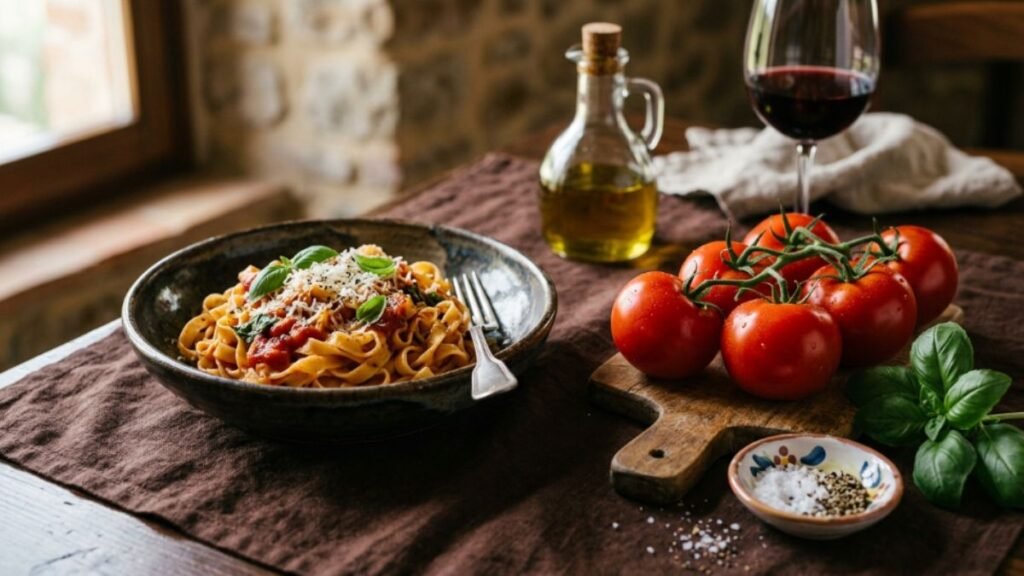
The single largest shock to Italian cooking arrived from across the Atlantic. The exchange of plants that followed European contact with the Americas delivered tomatoes, peppers, maize, beans, and potatoes into Mediterranean kitchens. The long journey of the tomato from suspicion to staple reshaped the southern table more than any conquest had. It is impossible to imagine modern Italian food without ingredients that did not exist in Italy until the sixteenth century.
The Tomato’s Long Road to the Plate
When the tomato first reached Italy, it was grown as an ornamental curiosity and widely mistrusted, partly because it belongs to the nightshade family. Decades passed before anyone cooked with it seriously. A Neapolitan court steward recorded an early tomato sauce in 1692, but the marriage of tomato and pasta that now defines Italian cuisine to outsiders did not become common until the late eighteenth and nineteenth centuries, and it took hold first in and around Naples. Maize followed a parallel path in the north, where it replaced older grains to become the polenta of everyday meals. The irony is sharp: several of the ingredients foreigners consider most quintessentially Italian are, by origin, entirely American. To see how the tomato eventually anchored an entire repertoire, our collection of traditional regional pasta dishes and their sauces maps the result.
This regional patchwork is also why Italian food resists easy summary. The cooking of Bologna has little in common with that of Palermo, and a traveler moving south to north passes through what feel like separate countries of flavor. Reading about that diversity is one thing; tasting it in the streets where it developed is another.
For travelers who would rather experience this living history than only study it, a guided food walk through a historic Italian city center turns centuries of culinary evolution into an afternoon you can actually taste, with a local guide explaining why each bite belongs to that exact place.
Unification and the Invention of Italian Food
Italy did not become a unified country until 1861, and at that moment the idea of a shared national cuisine barely existed. People spoke different dialects, used different weights and measures, and cooked from entirely separate traditions. A dish that was ordinary in one region could be unknown a hundred miles away. If Italian food was going to mean anything as a national concept, someone had to gather the fragments and write them down in a common language.
Pellegrino Artusi and a Shared Culinary Language
That work fell, almost by accident, to a retired silk merchant named Pellegrino Artusi. His 1891 book gathered hundreds of recipes from across the peninsula and presented them in clear, standardized Italian for home cooks, blending regional dishes into something that could be read and reproduced anywhere. It became a runaway success and a fixture in Italian households, helping to forge a sense that these scattered regional kitchens belonged to a single culinary family. In a real sense, the notion of national Italian cooking was authored as much as it was inherited. The same impulse to record origins, not just methods, drives our own series on the history behind individual dishes, including the unlikely birth of Italy’s most beloved layered dessert.
Emigration and the Global Italian Table
Almost as soon as Italy was unified, millions of its people left. Between roughly 1880 and the 1920s, waves of emigrants, most from the poorer south, carried their cooking to the Americas and beyond. In their new homes, scarcity gave way to abundance, and the cuisine adapted accordingly. Meat that had been rare became plentiful, portions grew, and dishes that barely existed in Italy took on a life of their own abroad. Much of what the world pictures when it hears the words Italian food is, in truth, the cooking of this diaspora rather than the cooking of the peninsula.
This split between authentic regional cuisine and its global descendants is not a failure of authenticity but a continuation of the same process that brought tomatoes, sugar, and durum wheat into Italy in the first place. Food travels, adapts, and becomes something new wherever it lands. Recognizing this makes a traveler more curious and a cook more honest about where a recipe really comes from.
Cucina Italiana Today: Tradition as a Living Practice
Modern Italy guards its culinary heritage with unusual seriousness. European protections such as DOP and IGP labels legally tie specific products to specific places, so that a cheese or a vinegar made outside its home region cannot claim the name. The Slow Food movement, founded in the Piedmontese town of Bra in 1986 as a reaction against fast food, turned this protective instinct into a global philosophy built around local producers and traditional methods. Regional pride, sometimes called campanilismo, remains so strong that an Italian cook may defend a grandmother’s version of a sauce as fiercely as any matter of identity.
Yet tradition in Italy is not frozen. The best contemporary kitchens treat inherited techniques as a foundation to build on rather than a museum to preserve. New ingredients, lighter methods, and global influences keep entering the repertoire, exactly as they always have. What looks like timeless authenticity is better understood as a tradition confident enough to keep changing while remembering where it began.
Why This History Still Shapes Every Italian Meal
Every plate of Italian food carries these layers at once: a Roman pantry, an Arab harvest, a Renaissance court, an American garden, a national project, and a global migration. Cooking authentically, or even ordering well in a trattoria, becomes far more rewarding once you can feel that history in the ingredients. The food stops being a list of recipes and becomes a record of who passed through, what they planted, and what they refused to give up. Readers who want to follow this full arc in greater depth often turn to a well-sourced narrative history of the Italian table, which traces the same journey from antiquity to the present in a single volume.
Frequently Asked Questions about Italian Cuisine History
When did Italian cuisine as we know it begin?
There is no single starting point. The agricultural foundation of grain, olive, and wine dates to ancient Rome, but the food most people recognize as Italian, built around tomatoes and dried pasta, only took shape between the sixteenth and nineteenth centuries, after New World ingredients arrived and after national unification in 1861.
Did the ancient Romans eat pasta?
Not in the modern sense. Romans ate grain mainly as porridge and bread, and while they made simple sheets of dough, the dense culture of dried, shaped pasta developed later, with hard durum wheat playing a key role in medieval Sicily.
Why is Italian food so different from region to region?
Italy was a collection of separate states for most of its history and only unified in 1861. Each territory developed its own staples, fats, and dishes, so northern cooking leans on butter and rice while the south favors olive oil and wheat. That diversity is the structure of the tradition, not an exception to it.
Are tomatoes really not originally Italian?
Correct. Tomatoes are native to the Americas and reached Italy only in the sixteenth century, where they were treated with suspicion for decades before becoming central to southern cooking. The same is true of maize, peppers, and beans.
Did Catherine de Medici invent French cuisine?
Almost certainly not. The popular legend that she brought Italian refinement to France in 1533 is widely repeated but rejected by most historians, since French cooking was already advanced and the evidence for a single decisive influence is weak.
What is the difference between authentic Italian food and Italian-American food?
Italian-American cuisine grew out of emigration around 1880 to 1920, when cooks adapted regional recipes to the abundance of a new country. Larger portions and certain meat-heavy dishes became staples abroad that were rare or unknown in Italy, so the two cuisines are related but distinct.
Is the Mediterranean diet the same as historical Italian eating?
Is the Mediterranean diet the same as historical Italian eating?
Closely related. The plant-forward pattern of grains, legumes, vegetables, and olive oil that defines the Mediterranean diet descends directly from the Roman and medieval pantry, which is why it is treated as a long-standing cultural tradition rather than a modern health trend.

Mary Ciss is a food writer and Italian gastronomy enthusiast with a passion for authentic recipes, culinary history, and the stories behind every dish. Through Mio Gelatto, she explores the real flavors of Italy — from centuries-old gelato traditions to the hidden trattorias that locals love. For Mary, every recipe is a journey.