

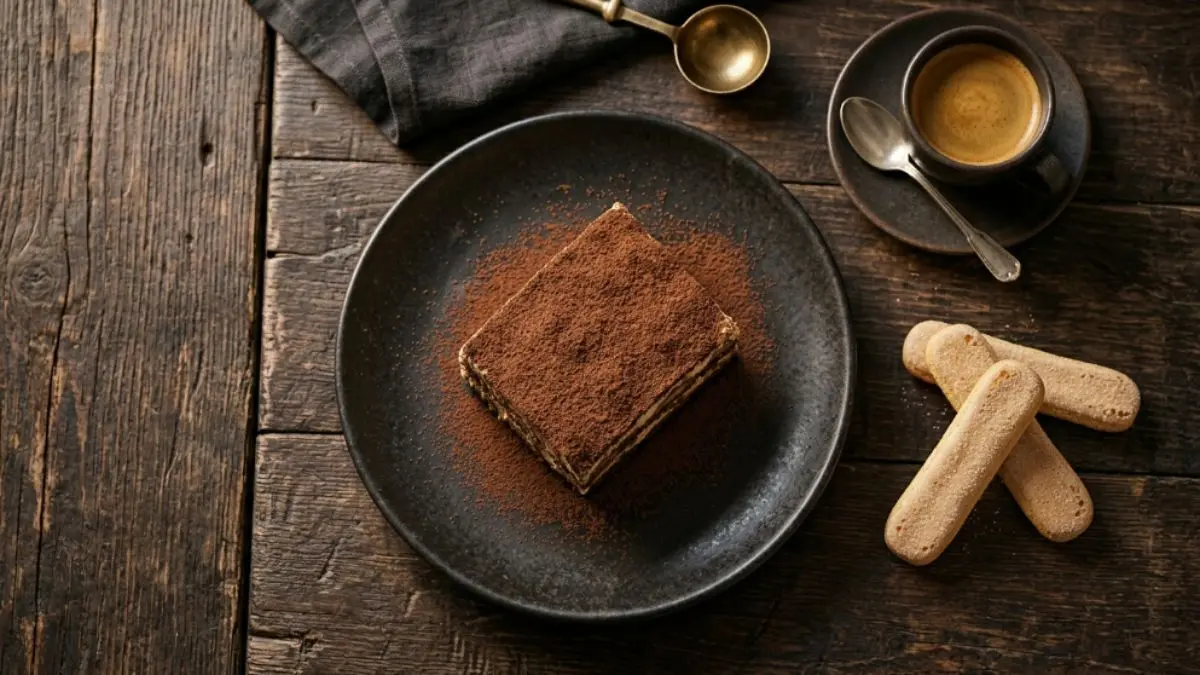
The History Behind Tiramisu: Italy’s Most Beloved Dessert
The History Behind Tiramisu begins in a small restaurant in Treviso, where one of the world’s most beloved desserts was born in the early 1970s. Yet beneath its creamy surface lies a history as rich and complex as its flavor — one marked by regional pride, competing claims, and a surprisingly recent origin for a dessert that feels so timeless.
In this article, we trace the history of tiramisu from its disputed birthplace in northeastern Italy to its rise as one of the most recognized Italian desserts in the world. Along the way, we will explore its key ingredients, the traditions that shaped it, and what makes the authentic version so different from the countless imitations that have followed.
Tira mi su — three simple Italian words that translate to "pick me up." For a dessert built on espresso and sugar, no name could be more fitting.
Quick Facts: Tiramisu at a Glance
| Origin | Treviso, Veneto, Italy |
| First documented | 1960s–1970s |
| Creator (disputed) | Roberto Linguanotto / Ado Campeol |
| Key ingredients | Savoiardi, mascarpone, espresso, eggs, sugar |
| Italian classification | Regional traditional product (PAT) |
| Name meaning | Tira mi su — Pick me up |
| Global reach | One of the most replicated Italian desserts worldwide |

The History Behind Tiramisu: Where It All Began
The origin of tiramisu is one of the most passionately debated subjects in Italian gastronomy. Unlike pizza, which belongs unmistakably to Naples, or carbonara, which claims Rome as its home, tiramisu has at least two cities fighting for the title of birthplace: Treviso and Friuli Venezia Giulia.
The Treviso Claim
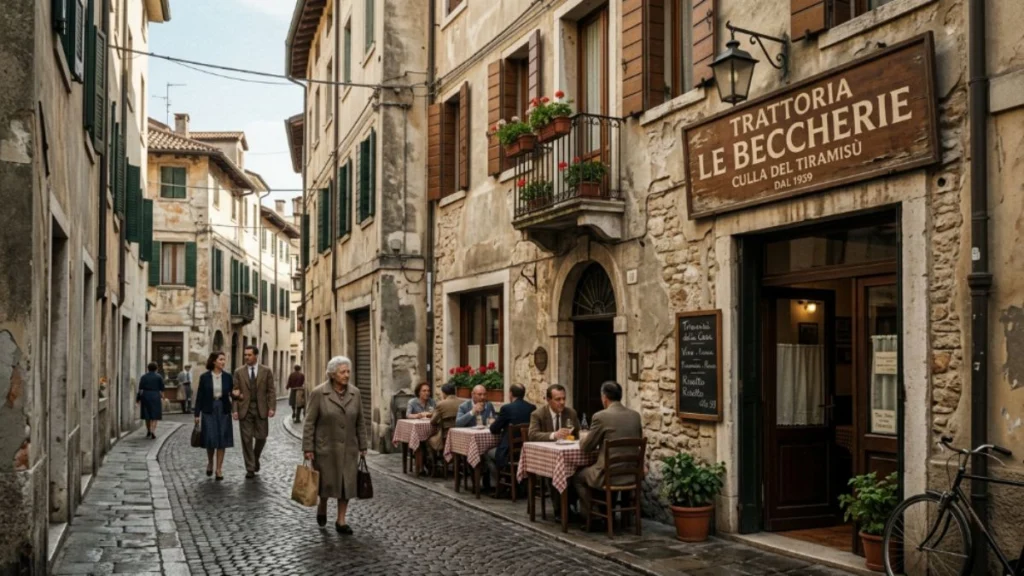
The most widely accepted version of tiramisu’s origin places its creation in the city of Treviso, in the Veneto region of northeastern Italy. The story centers on Le Beccherie, a historic restaurant that has been part of the city’s culinary fabric since 1939. According to the restaurant’s account, tiramisu was first prepared in the early 1970s by the pastry chef Roberto Linguanotto, working alongside the restaurant owner Ada Campeol.
The dessert was reportedly created as a variation of a traditional Venetian restorative dish — a mixture of eggs beaten with sugar and marsala wine, given to the elderly, to new mothers, or to anyone who needed a boost of energy. Linguanotto and Campeol elevated this concept by incorporating mascarpone cheese and coffee-soaked savoiardi biscuits, creating the layered dessert we recognize today.
In 2010, the Italian Academy of Cuisine officially registered the recipe from Le Beccherie as the authentic tiramisu of Treviso — a recognition that carries significant cultural weight in a country where regional culinary heritage is taken seriously.
The Friuli Counter-Claim
Not everyone agrees. The region of Friuli Venezia Giulia, specifically the town of Tolmezzo, has also claimed tiramisu as its own. Some food historians point to a dessert called “Tireme Su” served at a restaurant in Tolmezzo during the 1950s and 1960s as a possible precursor. The debate has never been fully resolved, and it continues to spark lively discussions in Italian culinary circles.
For our purposes, and in line with the Italian government’s official recognition, we follow the Treviso attribution — though we acknowledge the complexity of tracing any dish’s true origin.
The Anatomy of an Authentic Tiramisu
What separates an authentic Italian tiramisu from its many international imitations is not just the recipe — it is the philosophy behind each ingredient. Every component was chosen deliberately, and understanding why makes the dessert far more meaningful.
Savoiardi: The Foundation
Savoiardi, known in English as ladyfingers, are the structural backbone of tiramisu. These light, sponge-based biscuits originated in the court of the Duchy of Savoy in the late 15th century, making them one of the oldest baked goods in Italian culinary history. Their porous texture makes them ideal for absorbing espresso without dissolving completely — the key to achieving that perfect bite that is moist at the center but still holds its shape.
Mascarpone: The Cream of Lombardy
Mascarpone is a fresh, soft cheese produced primarily in Lombardy. Its texture sits somewhere between heavy cream and cream cheese, with a mild, slightly sweet flavor that provides the dessert’s characteristic richness. Authentic tiramisu uses only mascarpone — not whipped cream, not cream cheese, not ricotta. These substitutions, common in international versions, change the flavor profile dramatically.
The cheese is typically combined with egg yolks and sugar to create a custard-like mixture that is then folded with whipped egg whites or cream for lightness. The result is the silky, voluminous layer that defines the dessert.
Espresso: The Soul of the Dish
Coffee is not an incidental ingredient in tiramisu — it is the soul of the dish. The savoiardi are dipped in strong espresso, typically unsweetened, which provides a bitter counterpoint to the sweetness of the cream and sugar. Some traditional recipes add a small amount of marsala wine or rum to the espresso, adding depth and a subtle warmth to each bite.
The quality of the espresso matters enormously. A weak or poorly extracted coffee will produce a flat, uninspiring result. A properly brewed, full-bodied Italian espresso transforms the dessert entirely.
Eggs, Sugar, and Cocoa
Traditional tiramisu uses raw egg yolks, beaten with sugar until pale and thick. This technique, borrowed from the classic zabaglione preparation, gives the cream its density and depth. Modern concerns about raw eggs have led many cooks to use pasteurized eggs or a cooked zabaglione base — both are acceptable adaptations, though the texture differs slightly.
Finally, the surface is dusted with unsweetened cocoa powder. Not grated chocolate, not chocolate shavings — just a fine, even layer of pure cocoa that adds a faint bitterness and a beautiful finish.
The Classic Authentic Tiramisu Recipe
This is the recipe as it has been prepared at Le Beccherie in Treviso for decades. No cream, no gelatin, no shortcuts — just the original.
Ingredients (serves 6-8)
- 6 egg yolks
- 150g (3/4 cup) granulated sugar
- 500g (18 oz) mascarpone cheese, at room temperature
- 4 egg whites, stiffly beaten
- 300ml (1 1/4 cups) strong espresso, cooled
- 2 tablespoons marsala wine (optional, traditional)
- 30 savoiardi (ladyfinger biscuits)
- Unsweetened cocoa powder, for dusting
Method
Beat the egg yolks with the sugar in a large bowl until the mixture is pale, thick, and falls in ribbons from the whisk. This process takes approximately 5 minutes by hand or 3 minutes with an electric mixer. The thorough beating of the yolks is essential — it creates the light, airy base of the cream.
Add the mascarpone to the yolk mixture and fold gently until smooth and fully incorporated. Do not beat or overwork the mixture at this stage; you want to preserve as much air as possible.
In a separate, clean bowl, beat the egg whites to stiff peaks. Fold the beaten whites into the mascarpone mixture in three additions, using a large spatula and a gentle folding motion. The final cream should be light, voluminous, and smooth.
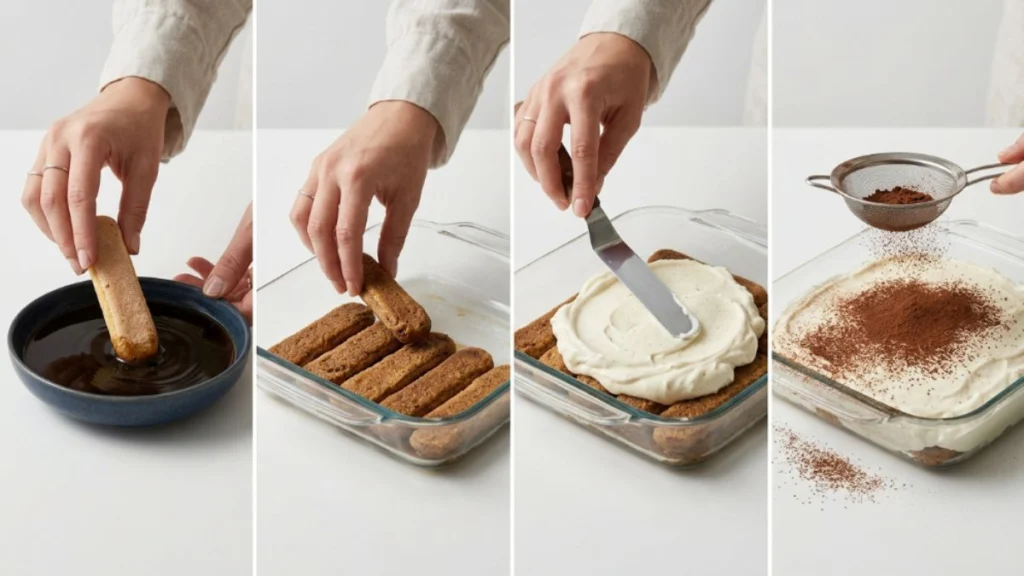
Prepare the espresso and allow it to cool completely. Add the marsala wine if using. Dip each savoiardo quickly in the espresso — a brief, one-second dip on each side is sufficient. The biscuit should be moistened, not saturated.
Arrange a layer of dipped savoiardi in a rectangular dish, approximately 20×30 cm. Spread half of the mascarpone cream over the biscuits in an even layer. Add a second layer of dipped savoiardi, then the remaining cream. Smooth the surface.
Refrigerate the tiramisu for a minimum of 4 hours, though overnight is ideal. Before serving, dust generously with unsweetened cocoa powder passed through a fine sieve.
The resting time is not optional. The flavors need time to meld, and the cream needs time to set. A tiramisu made and served on the same day will never be as good as one prepared the night before.
Tiramisu Around the World: The Good, The Bad, and The Unrecognizable
The global spread of tiramisu has been remarkable — and not always faithful. In many countries, the dessert has been adapted, simplified, and reinvented to the point where it bears little resemblance to the Treviso original. Cream cheese replaces mascarpone. Instant coffee stands in for espresso. Whipped cream is folded in for ease. Alcohol is removed for accessibility. The result is a softer, sweeter, less complex dessert that satisfies a sweet tooth but misses the point entirely.
There are also notable variations that deserve respect, even if they differ from the original. In Japan, tiramisu has been elevated to an art form, with artisan versions using premium local mascarpone equivalents and precisely controlled espresso ratios. In Brazil, it appears in countless forms as a celebration dessert. In the United States, it has become a staple of Italian-American restaurants, though the quality varies enormously.
The Italian government’s PAT designation (Traditional Agri-food Products) for the Treviso recipe offers some protection, but it applies within Italy. Outside Italian borders, the name tiramisu carries no legal protection and can be applied to almost anything layered and coffee-flavored.
Our perspective is this: there is room for creativity and adaptation in cooking, but there is also value in understanding and preserving the original. When we make tiramisu at home or seek it in a restaurant, knowing what the authentic version looks, tastes, and feels like makes the difference between a good dessert and a truly meaningful one.
Where to Find Authentic Tiramisu in Italy
If you are traveling to Italy and want to experience tiramisu at its source, Treviso is the obvious starting point. Le Beccherie still serves the original, and the city’s culinary scene has grown around its most famous export. A stroll through Treviso’s historic center — with its canals, medieval walls, and arcaded streets — is a fitting backdrop for what will likely be a memorable dessert experience.
Beyond Treviso, the Veneto region offers excellent tiramisu throughout. In Venice, smaller bacari (traditional wine bars) and family-run trattorie often serve handmade versions prepared daily. In Verona, the dessert appears alongside the city’s famous local wines. In Padova, it anchors the dessert menus of restaurants that have been operating for generations.
Outside of Veneto, quality tiramisu can be found across Italy — but the further you stray from the dessert’s home region, the more variation you will encounter. In Rome, you are as likely to find an excellent tiramisu as a mediocre one. In Naples, the dessert exists but competes with the city’s own extraordinary pastry tradition.
YOU MIGHT BE INTERESTED TO KNOW: The Gelato Route: Best Gelaterias in Italy and How to Visit Them
The Legacy of a Simple Dessert
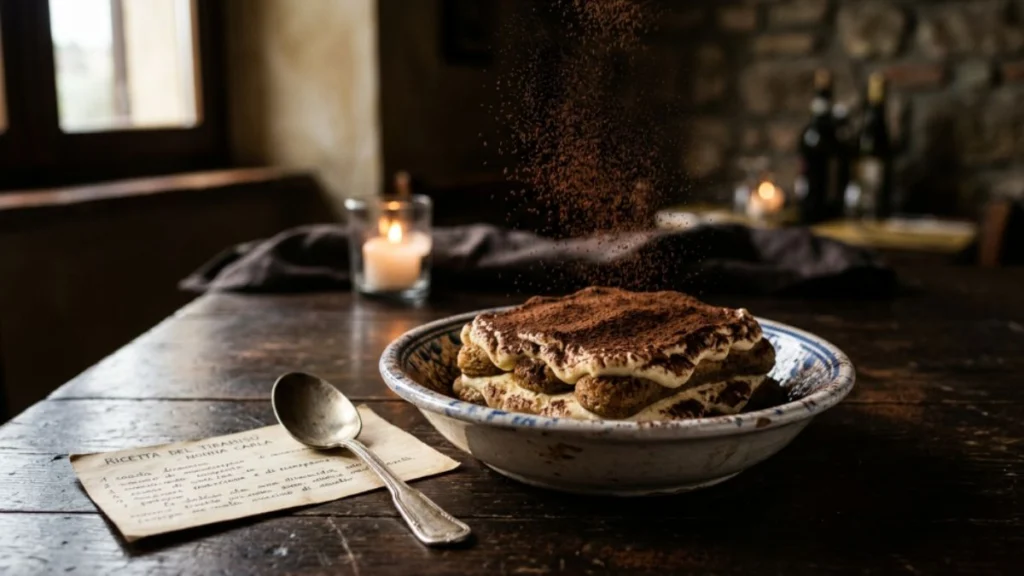
It is remarkable that a dessert created in a Treviso restaurant some fifty years ago has traveled so far and adapted so readily to so many cultures. Tiramisu succeeded not because it was fashionable or novel, but because its balance of flavors — bitter coffee, sweet cream, delicate cocoa — is nearly perfect.
Its story is also a reminder of how Italian cuisine works at its best: not through complexity or pretension, but through the careful selection of quality ingredients and respect for technique. The mascarpone must be good. The espresso must be strong. The eggs must be fresh. The rest follows naturally.
When we make tiramisu — truly make it, following the original method — we are participating in a tradition that connects us to a small city in Veneto, to a pastry chef and a restaurant owner who wanted to create something special, and to every Italian home cook who has passed this recipe to the next generation.
That is what food does when it is made with care. It carries history forward.
Frequently Asked Questions About Tiramisu
Does authentic tiramisu contain alcohol?
Traditional recipes from Treviso typically include a small amount of marsala wine in the espresso dip. However, alcohol is not universally present in Italian versions, and many home cooks omit it. If you prefer no alcohol, simply use plain espresso — the dessert remains authentic in spirit.
Is tiramisu safe to eat raw eggs?
Authentic tiramisu uses raw eggs, which poses a small but real food safety concern, particularly for vulnerable groups including pregnant women, the elderly, and immunocompromised individuals. Using pasteurized eggs eliminates this risk entirely without significantly altering the flavor or texture.
Can I substitute cream cheese for mascarpone?
Technically yes, but the result will not be authentic tiramisu. Mascarpone has a higher fat content, a milder flavor, and a smoother texture than cream cheese. The substitution produces a denser, tangier, less refined dessert. For the real thing, it is worth seeking out proper mascarpone.
How long does tiramisu last in the refrigerator?
Properly covered, tiramisu will keep in the refrigerator for 2 to 3 days. The flavor often improves on the second day as the components have more time to meld. After 3 days, the savoiardi become too soft and the cream begins to lose its structure.
Why is it called tiramisu?
The name translates literally as “pick me up” or “lift me up” — a reference to the energizing combination of espresso and sugar. There is a folk tradition that the dessert was used as a restorative in Venetian culture, though the modern recipe is a 20th-century creation.
What is the difference between tiramisu and charlotte?
Both use ladyfinger biscuits as a structural element, but the similarities largely end there. Charlotte is a French dessert typically made with fruit compote or bavarian cream, often molded and unmolded for presentation. Tiramisu is an Italian dessert built on coffee, mascarpone, and eggs, assembled in layers and served directly from the dish.
Is tiramisu gluten-free?
Traditional tiramisu is not gluten-free, as savoiardi biscuits are made with wheat flour. However, it is possible to make a gluten-free version using certified gluten-free ladyfinger substitutes. The mascarpone cream itself contains no gluten.

Mary Ciss is a food writer and Italian gastronomy enthusiast with a passion for authentic recipes, culinary history, and the stories behind every dish. Through Mio Gelatto, she explores the real flavors of Italy — from centuries-old gelato traditions to the hidden trattorias that locals love. For Mary, every recipe is a journey.