Italian Pizza Dough: Why Yours Never Tastes Authentic at Home
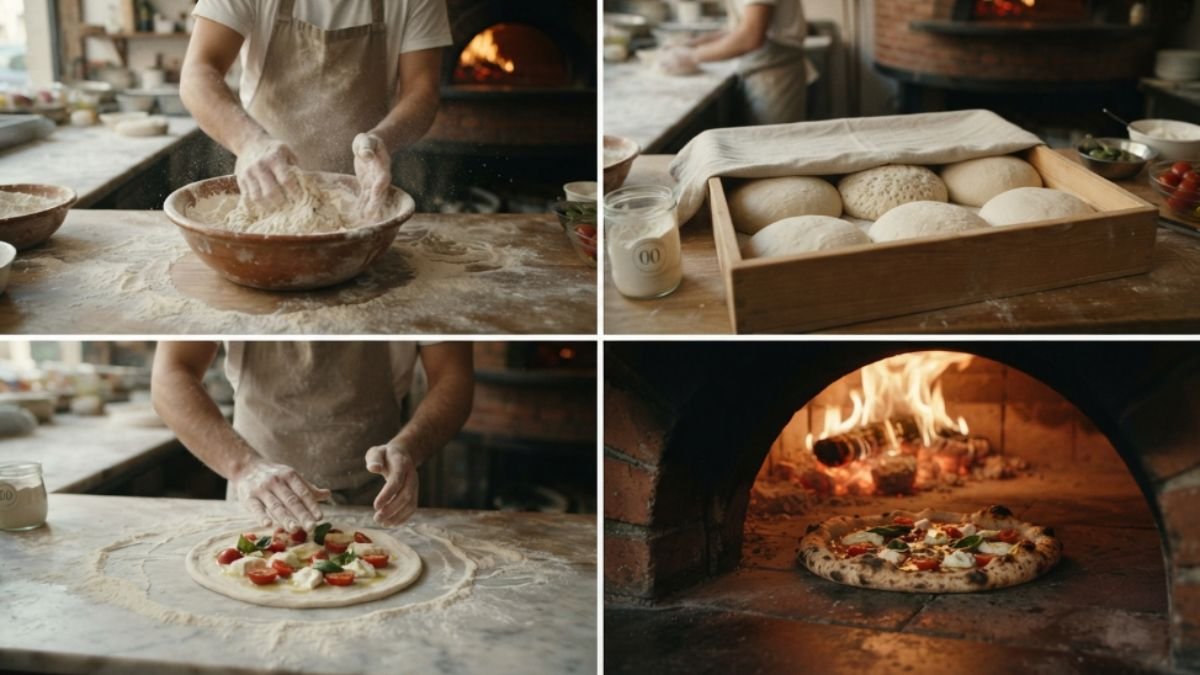
Italian pizza dough looks almost too simple to get wrong: flour, water, salt, and a whisper of yeast. Yet the same four ingredients that produce a blistered, feather-light Neapolitan crust somehow turn dense, pale, and vaguely bready in most home kitchens.
We have made this dough hundreds of times, in wood-fired ovens in Campania and in ordinary electric ones, and the gap almost never comes down to a hidden ingredient. It comes down to a handful of decisions that recipes rarely bother to explain.
If your homemade version keeps landing somewhere between a focaccia and a cracker, the problem is not your hands and it is not bad luck. It is usually one of four levers pulled in the wrong direction: the flour you chose, how much water you added, how long you let time do its work, and how much real heat your oven can deliver. Understand those four, and the distance between a home kitchen and a Naples pizzeria narrows dramatically.
Disclosure: Some links in this article are affiliate links. If you buy through them, we may earn a small commission at no additional cost to you. We only point to tools we believe genuinely help.
What Makes Italian Pizza Dough Taste Different
The Italian approach treats dough as an ingredient in its own right, something that develops character over hours or days, rather than a base you throw together an hour before dinner. That single shift in mindset explains most of the flavor most home cooks are missing. A well-made crust carries a faint tang, a savory depth, and a chew that a rushed dough simply cannot fake.
The most codified example is Neapolitan pizza, whose method is defined down to the ingredient list and the shaping technique by the Italian association that certifies authentic Naples-style pizza, which allows only flour, water, salt, and yeast, and forbids a rolling pin entirely. It is a useful north star even if you never chase certification.
Italy does not have one pizza, though. A Roman pizza tonda is thin and crisp to the point of shattering, while a Neapolitan disc stays soft and foldable at the center. Knowing which you are aiming for changes every later decision, and it is worth understanding how these styles map across the country, something we cover in our guide to Italy’s food regions.

The Flour Myth Behind Authentic Italian Pizza Dough
Ask most people what makes Italian pizza dough authentic and they will say two words: double zero. Then they buy a bag labeled 00, follow their usual recipe, and end up with the same disappointing crust as before. The misunderstanding is understandable, because 00 does not mean what people think it means.
The 00 designation refers only to how finely the flour is milled, not to how strong it is. A silky grind feels professional in the hand, but grind has nothing to do with the protein that builds gluten and holds gas. You can buy a very fine 00 that is far too weak for a long rise, which is exactly what happens to home bakers who trust the label and skip the number that actually matters.
Reading a flour’s strength, not just its grind
The number that predicts success is protein content, often expressed on Italian bags as a W value that rates the flour’s strength. Higher protein and a higher W mean the dough can withstand long fermentation without collapsing into a sticky puddle. For a dough that ferments 24 hours or more, you want a strong flour, and baking-science resources on flour and gluten development explain why weaker flours simply run out of structural steam over that timeline.
When bread flour can stand in
Here is the practical liberation: if you cannot source a strong Italian 00, a good high-protein bread flour will often outperform a weak 00 for long-fermented dough. The crumb turns slightly chewier and less delicate, but the structure is dependable and the flavor holds. Authenticity lives in the method far more than in the bag, and pretending otherwise keeps a lot of home bakers stuck.
| Flour type | Protein & strength | Best suited for | What to expect at home |
|---|---|---|---|
| Italian 00 (weak, common retail) | 9–11% protein, low W (~180–240) | Same-day or short rises | Soft, tender, but slack under long fermentation |
| Italian 00 (strong / pizza-grade) | 12.5–14% protein, high W (~300+) | Long cold fermentation, Neapolitan style | Elastic, holds structure for 24–72 hours |
| Bread flour (high-protein) | 12–13% protein | A capable stand-in for strong 00 | Slightly chewier crumb, excellent structure |
| All-purpose | 10–11% protein | Convenience, thin crusts | Workable but weaker; tears more easily when stretched |
Rule of thumb: Match your flour to your timeline. Short rise, weaker flour is fine. Long cold ferment, reach for strong 00 or high-protein bread flour.
Hydration: The Number Home Bakers Get Wrong
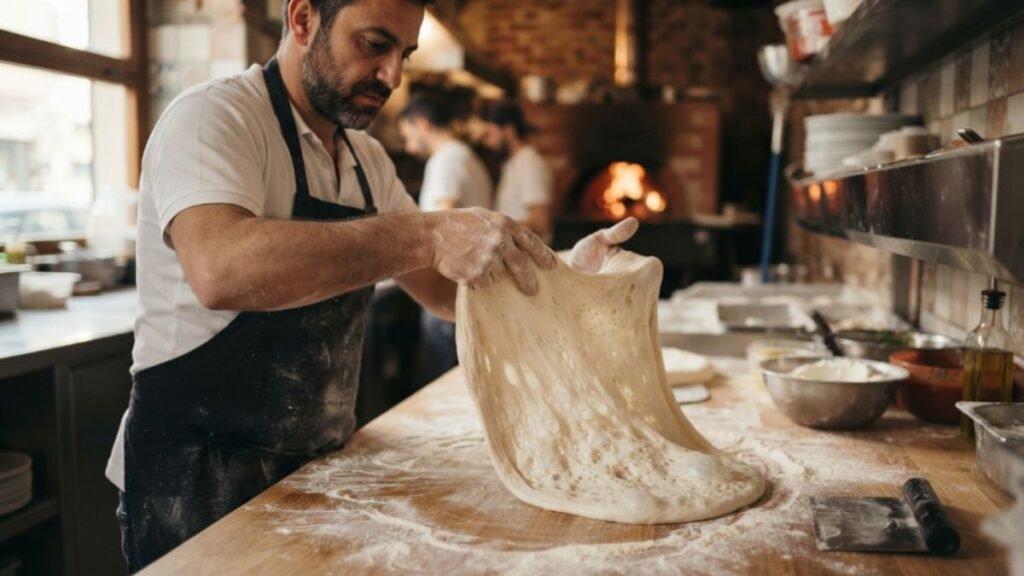
Hydration is the weight of water expressed as a percentage of the weight of flour, and it quietly governs the entire texture of your crust. Most supermarket recipes drift toward 55 to 58 percent, which produces a stiff, easy-to-handle dough and a tight, dry crumb. Neapolitan dough typically lives closer to 62 to 65 percent, and that extra water is a large part of why the finished crust has those irregular, airy holes.
Higher hydration is harder to handle, which is why beginner recipes avoid it, but the payoff is exactly the open, tender interior people associate with real Italian pizza. The catch is precision. Measuring flour by the cup is the single most reliable way to sabotage hydration, because a packed cup can hold far more flour than a loose one, and your carefully planned ratio evaporates. Weighing everything in grams is not fussiness here; it is the difference between a dough that behaves and one that does not.
Why Time Does More Than Yeast Ever Will
If we could change only one habit in the average home kitchen, it would be this: use less yeast and far more time. Piling in yeast to make the dough rise in two hours produces gas without flavor, and often a gummy, yeasty aftertaste. The character of a great crust comes from slow fermentation, the same principle that gives sourdough and aged cheese their depth.
Cold fermentation and where flavor comes from
A long rest in the refrigerator, often 24 to 48 hours, lets enzymes slowly break starches into simple sugars while organic acids develop. Those sugars later caramelize into color and the acids contribute that faint, savory tang. Research on how fermentation transforms wheat dough also points to improved digestibility, one reason a properly fermented Neapolitan crust feels lighter than a fast supermarket one.
Learning to read the dough instead of the clock
Fermentation is driven by temperature, so a recipe’s timing is only a guideline. A warm kitchen speeds everything up; a cold one slows it down. Rather than trusting the clock, learn to read the dough: it should roughly double, feel airy and domed, and spring back slowly when gently poked. If your finger leaves a dent that fills in immediately, it needs more time. If it collapses, it has gone too far. This same patience underpins nearly every Italian bread, including the technique in our step-by-step focaccia guide, where slow proofing turns four humble ingredients into something memorable.
The Heat Problem: Why Your Oven Fights You
Here is the hard truth no flour can fix. A Neapolitan oven runs around 800 to 900 degrees Fahrenheit and bakes a pizza in 60 to 90 seconds. A domestic oven tops out near 500 to 550 degrees. That gap is why home pizzas emerge pale and dry: the crust bakes so slowly that it dehydrates before it can char, leaving you with something closer to toast than to pizza.
You cannot turn a kitchen oven into a wood-fired one, but you can narrow the gap by giving it a surface that stores and radiates intense heat. Preheating a heavy, heat-retaining slab for a full 45 to 60 minutes, then baking directly on it with the broiler engaged, is the closest a home cook gets to that fast, fierce bottom heat.
For anyone tired of pale, crackery bottoms, a way to load your oven with the kind of stored, radiant heat it cannot generate on its own is the upgrade that changes the result more than any other single purchase, because it finally lets the crust blister the way it should.
Field note: Preheat longer than feels reasonable. Most home pizzas fail because the baking surface never fully saturated with heat, not because the oven wasn’t hot enough.
Shaping Italian Pizza Dough Without Killing the Air
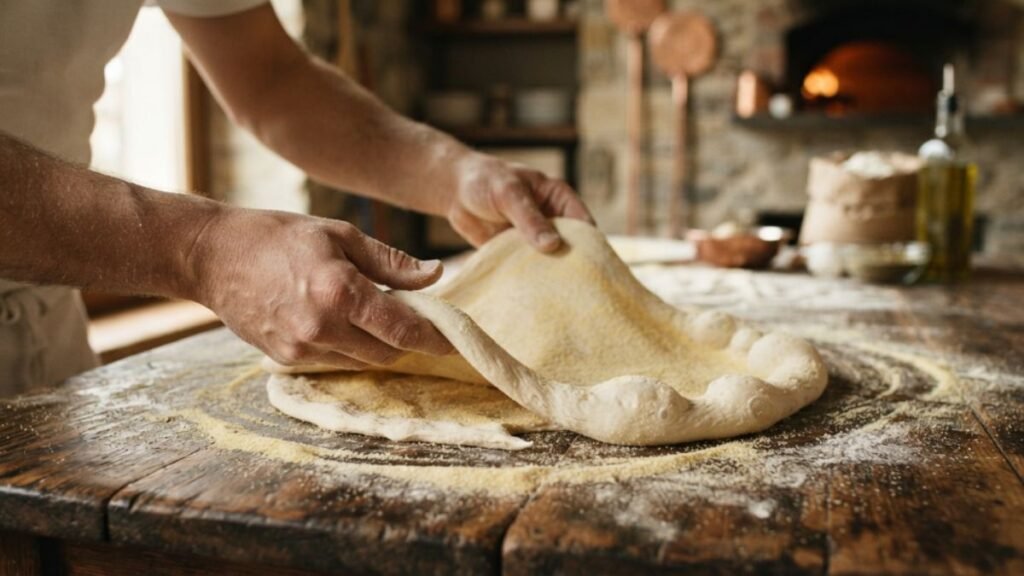
After days of building gas and structure, the final mistake is easy to make in seconds: reaching for a rolling pin. Rolling crushes every bubble you patiently developed and gives you a flat, uniform disc with no rim. The Italian method stretches the dough by hand, pressing from the center outward while leaving the outer edge, the cornicione, untouched so it can puff into that signature airy crown.
Handle the dough gently and only when it has warmed slightly from the fridge, since cold dough is tight and tears. Dust your bench with a little semolina or flour to prevent sticking, and move quickly. If the disc resists and snaps back, it simply needs a few more minutes of rest before it will relax and stretch.
The Small Mistakes That Flatten Authentic Flavor
Even with the big four handled, a few quiet habits keep home pizza from tasting Italian. None of them are difficult to fix once you know to look for them:
- Over-flouring the dough during shaping, which dries the surface and dulls the crust.
- Baking straight from the fridge, so the cold dough tears and bakes unevenly.
- Adding oil and sugar to a Neapolitan-style dough, which belongs to other styles, not to Naples.
- Drowning the pizza in toppings, which steams the crust instead of letting it crisp.
- Under-preheating the oven and baking surface, the most common failure of all.
The through-line is respect for simplicity. Italian cooking, as we explore across our look at the history of Italian cuisine, tends to earn its depth from technique and time rather than from long ingredient lists, and pizza dough is one of its purest lessons.
Bringing Italy Into Your Own Kitchen
Authentic Italian pizza dough is not guarded by a secret recipe. It is the sum of four honest choices: a flour strong enough for your timeline, enough water to open the crumb, enough time for flavor to develop, and enough stored heat to char the crust. Get those aligned and the mystique falls away, replaced by a method you can repeat any night of the week.
Precision is the quiet backbone of all of it, because small errors in the flour-to-water ratio compound into big differences in the pan. If there is one upgrade that repays itself immediately, it is trading guesswork for a dependable way to weigh your flour and water to the gram, which is where consistent Italian dough genuinely begins. Master the ratio, respect the rest, and your kitchen will start turning out crusts that taste like they came from somewhere along the Amalfi coast.
If working the dough by hand has you curious about other from-scratch Italian staples, our authentic Italian pasta recipes build on the same respect for flour, water, and patience.
Frequently Asked Questions
What flour is closest to Italian 00 if I cannot find it?
A high-protein bread flour, around 12 to 13 percent protein, is the best substitute for a strong Italian 00, especially for long-fermented dough. The crumb will be slightly chewier, but the structure and flavor hold up beautifully.
How long should Italian pizza dough rise?
For real depth of flavor, aim for a cold fermentation of 24 to 48 hours in the refrigerator. A same-day dough is possible in four to six hours at room temperature, but it will always taste flatter than a slow-fermented one.
Can I make authentic pizza dough without a pizza oven?
Yes. You cannot match 900-degree heat, but preheating a heavy heat-retaining surface for an hour and finishing under the broiler gets a home oven remarkably close to a proper charred crust.
Why does my dough keep tearing when I stretch it?
Two common causes: the dough is too cold and tight, or the flour is too weak for the fermentation time. Let it warm slightly before shaping, and use a stronger flour for long rises.
Should I add olive oil to Neapolitan dough?
Traditional Neapolitan dough uses only flour, water, salt, and yeast, so no oil. Other Italian styles do use it, and the quality of that oil matters, which is why we dig into it in our guide to extra virgin olive oil.
Can I freeze pizza dough?
Freeze it after the bulk fermentation, portioned into balls. Thaw overnight in the refrigerator, then let it come to room temperature before shaping. The texture stays excellent.
Why is my crust pale instead of golden and charred?
Pale crust almost always means not enough heat or too short a rise. Preheat your baking surface far longer, use the broiler, and give the dough a long ferment so its natural sugars can brown.

Mary Ciss is a food writer and Italian gastronomy enthusiast with a passion for authentic recipes, culinary history, and the stories behind every dish. Through Mio Gelatto, she explores the real flavors of Italy — from centuries-old gelato traditions to the hidden trattorias that locals love. For Mary, every recipe is a journey.