Authentic Italian Focaccia: The Complete Step-by-Step Guide
There is a bakery in the Genova neighborhood of Sestri Ponente that opens its doors at six in the morning. By six-fifteen, the line extends onto the sidewalk. The reason is a single tray of focaccia genovese, still steaming from the oven — its surface dimpled, glistening with olive oil, seasoned with coarse sea salt that catches the morning light. People buy it by the half-kilo, fold it like a newspaper, and eat it walking. No plate, no napkin, no ceremony required.
That scene is not unusual in Liguria. Focaccia — specifically the Genovese variety — is a daily staple in the region, consumed at breakfast, at lunch, as a snack, and as an accompaniment to the evening meal. It is so embedded in local culture that the Ligurian focaccia recipe holds an IGP (Indicazione Geografica Protetta) designation, which legally defines the proportions and methods required for authentic production.
We have made this bread dozens of times — adjusting hydration levels, experimenting with olive oil quantities, testing different proofing times and pan materials — until we arrived at a version that replicates the essential qualities of what you find in a Genovese panificio: a crust that cracks just slightly on the outside, a crumb that is open and soft with a faint chew, and a flavor defined entirely by the quality of the olive oil used.
This guide covers everything — the correct flour, the dough technique, the proofing process, the topping options, and the regional variations worth knowing. When you finish, you will have the knowledge to make authentic Italian focaccia that bears no resemblance to the thick, dry, herb-dusted bread sold under that name in American grocery stores.
What Makes Italian Focaccia Authentic: The Ligurian Standard
Before making focaccia, it helps to understand what you are actually trying to achieve — because the American idea of focaccia and the Ligurian original are significantly different products.
Focaccia Genovese: The Protected Standard
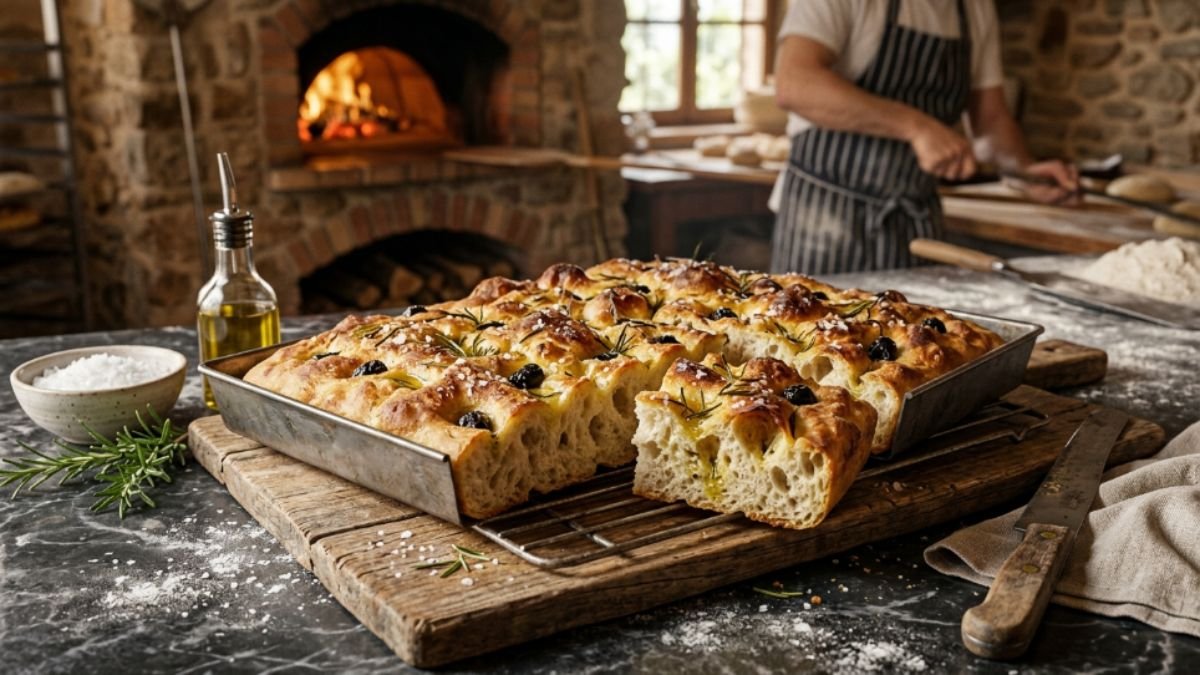
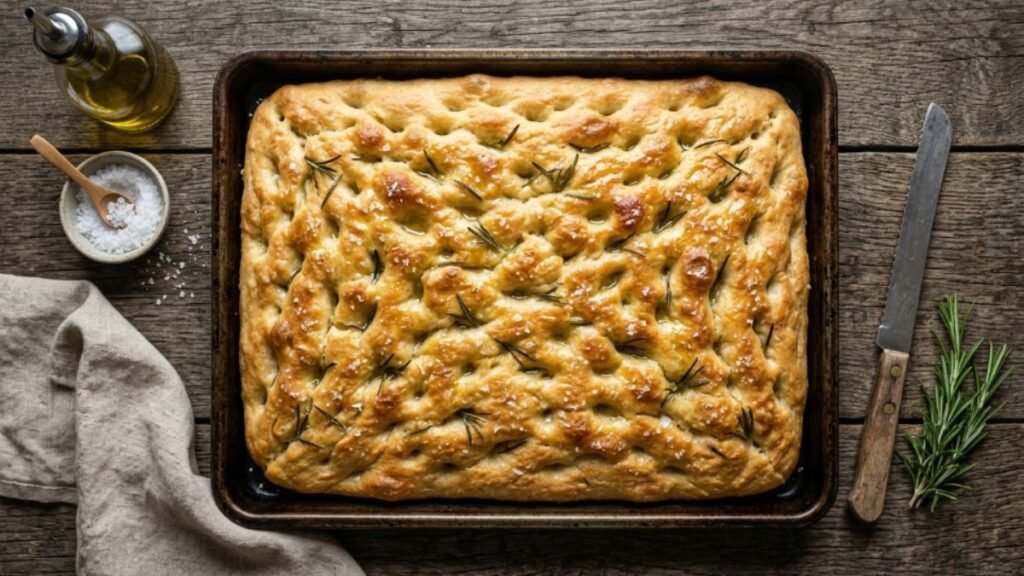
The IGP specification for Focaccia Genovese defines precise parameters: dough hydration between 55% and 65%, olive oil content of at least 10% by flour weight in the dough plus a generous surface application, thickness between 1.5 and 2 centimeters after baking, and characteristic surface dimples pressed with fingertips. The result is a flatbread that is simultaneously crispy and tender — a balance that requires both the right formula and correct technique.
The key differentiators from what most Americans know as focaccia:
- It is thinner than you expect. Authentic focaccia genovese is 1.5 to 2 centimeters thick — not the 4 to 5 centimeter slab served in many American Italian restaurants.
- The olive oil quantity is non-negotiable. The dough contains oil, the pan is generously coated with oil before the dough is placed, and additional oil and water are poured over the surface before the final proof. This is not a light bread.
- The surface is dimpled, not smooth. The finger dimples are structural — they create the shallow wells that hold the oil and salt on the surface during baking.
- Sea salt only. Coarse flaky sea salt on the surface provides bursts of salinity that contrast with the mild, oily bread. Fine salt dissolves and disappears.
Regional Variations Worth Knowing
Focaccia is not exclusive to Liguria — versions exist across Italy with significant differences in style and purpose:
| Style | Region | Key Characteristics | Thickness |
|---|---|---|---|
| Focaccia Genovese | Liguria | Olive oil-rich, dimpled, sea salt | 1.5–2 cm |
| Focaccia Barese | Puglia | Cherry tomatoes, olives, oregano | 2–3 cm |
| Focaccia di Recco | Liguria | Ultra-thin, filled with fresh cheese | 0.3–0.5 cm |
| Schiacciata | Tuscany | Thinner, less olive oil, crispy | 1–1.5 cm |
| Pizza Bianca | Rome | Very thin, crackerlike, rosemary | 0.5–1 cm |
For this guide, we focus on the Genovese version — the most technically precise and the one most worth mastering as a foundation.
Ingredients: What You Need and Why Each One Matters
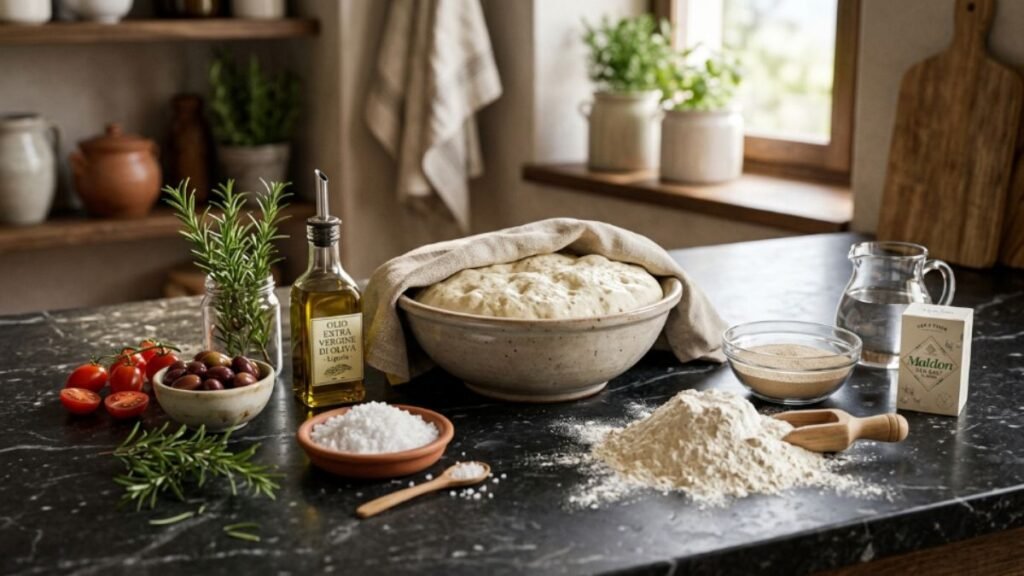
Focaccia uses a short list of ingredients. That simplicity means every choice is visible in the final product.
Flour
Italian focaccia is traditionally made with tipo 00 flour — a finely milled soft wheat flour with a protein content of approximately 9 to 11%. It produces a more tender, extensible dough than American bread flour and contributes to the characteristic soft crumb.
If tipo 00 flour is unavailable, all-purpose flour is an acceptable substitute. Bread flour, which has higher protein content, produces a chewier result — closer to a baguette texture than authentic focaccia. For the most authentic result, tipo 00 is worth sourcing.
👉 Antimo Caputo “00” Chef’s Flour
👉 King Arthur ’00’ Pizza Flour
Olive Oil
The olive oil is not background — it is the defining flavor of this bread. A robust Ligurian Taggiasca oil is traditional, but any good quality extra virgin olive oil with a clean, fruity flavor works well. Do not use light olive oil or any refined product — the flavor will be absent where it should be dominant.
👉 Filippo Berio Cold Pressed Extra Virgin Olive Oil
For everything worth knowing about how to choose and use quality extra virgin olive oil, our dedicated guide covers it in full — What Is Extra Virgin Olive Oil.
Yeast
Fresh yeast, as used in Italian bakeries, produces a slightly more complex flavor. Instant dry yeast works reliably and requires no activation step. Active dry yeast must be proofed in warm water before use. All three produce acceptable results — the differences are subtle at home baking scale.
Water
Room temperature water at approximately 68°F (20°C) is standard. The water temperature affects fermentation speed — cooler water slows it down, which generally improves flavor development. Tap water is fine in most American cities. If your tap water is heavily chlorinated, letting it sit for 10 minutes before use allows the chlorine to dissipate slightly.
Coarse Sea Salt
For the surface, flaky sea salt — Maldon, fleur de sel, or any coarse flaked variety — is essential. For the dough itself, fine sea salt or kosher salt dissolves more evenly.
The Dough Formula and Mixing Process
Ingredients (One 9×13 inch / 23×33 cm Pan — Serves 6–8)
| Ingredient | Quantity | Baker’s Percentage |
|---|---|---|
| Tipo 00 flour (or all-purpose) | 500g | 100% |
| Water (room temperature) | 325ml | 65% |
| Extra virgin olive oil (in dough) | 50ml | 10% |
| Instant dry yeast | 5g (1½ tsp) | 1% |
| Fine sea salt | 10g (1¾ tsp) | 2% |
| Extra virgin olive oil (for pan) | 50ml | — |
| Extra virgin olive oil (for surface) | 30ml | — |
| Water (for surface brine) | 30ml | — |
| Coarse sea salt (for surface) | 1–2 tsp | — |
Mixing by Hand
- In a large bowl, combine the flour, yeast, and fine salt. Whisk briefly to distribute evenly. Keep salt and yeast on opposite sides of the bowl initially — direct contact between salt and yeast in high concentration can inhibit yeast activity.
- Add the water gradually, mixing with a fork or your hand until a shaggy dough forms. Add the olive oil and continue mixing until the oil is fully incorporated and no dry flour remains.
- Turn the dough onto a lightly floured surface. Knead for 8 to 10 minutes until the dough is smooth, slightly tacky, and elastic. It should spring back slowly when pressed with a finger.
⚠️ Attention: Focaccia dough is wetter than pizza dough. If the dough feels very sticky at first, resist the temptation to add more flour — keep working it and it will become more manageable as the gluten develops. A slightly sticky dough produces a more open, airy crumb.
Mixing with a Stand Mixer
Combine all ingredients in the bowl of a stand mixer fitted with the dough hook. Mix on low for 2 minutes, then medium for 6 to 8 minutes until the dough is smooth and pulls away from the sides of the bowl cleanly.
Proofing, Panning, and Shaping: The Critical Steps
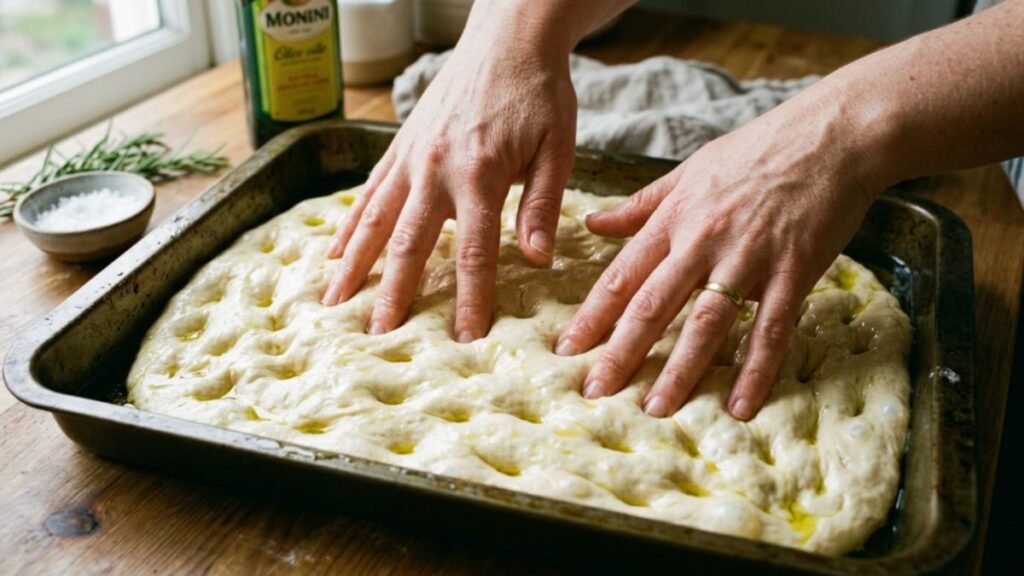
The proofing and panning stage is where most home bakers make errors that compromise the final texture. The sequence matters precisely.
First Proof (Bulk Fermentation)
Transfer the dough to a lightly oiled bowl, cover with plastic wrap or a damp cloth, and proof at room temperature (68–72°F / 20–22°C) for 1 to 1.5 hours, or until doubled in size.
For better flavor, a cold proof in the refrigerator overnight (8 to 12 hours) is strongly preferred. Cold-proofed focaccia develops a more complex flavor and a slightly more open crumb. Remove from the refrigerator 30 minutes before panning.
Panning
Pour the 50ml of olive oil for the pan into a 9×13 inch (23×33 cm) metal baking pan and spread it evenly across the bottom and slightly up the sides. The pan should be generously coated — this is not a trace amount.
Turn the dough into the pan. Using your fingertips, gently stretch it toward the corners. It will resist and spring back. This is normal. Leave it to relax for 20 minutes, then stretch again. After two or three rounds of stretching with resting periods, the dough will fill the pan.
💡 Practical Tip: A metal baking pan — not glass, not ceramic — conducts heat more efficiently and produces a crispier bottom crust. Dark metal pans produce a more deeply colored crust than light-colored ones. A well-seasoned baking pan or one used frequently for focaccia will produce better results than a brand new pan used for the first time.
👉 USA Pan Bakeware Half Sheet Pan
Applying the Surface Brine
In a small bowl, combine the 30ml of olive oil and 30ml of water. Whisk vigorously until temporarily emulsified — the mixture will look milky. Pour this over the stretched dough surface.
This oil-and-water brine is the defining step of focaccia genovese that distinguishes it from all other flatbreads. The water in the brine creates steam during baking, which keeps the interior moist while the surface crisps. The oil creates the characteristic golden sheen and flavor.
Dimpling
Using all ten fingers, press firmly and evenly across the entire surface of the dough, creating the characteristic indentations to a depth of approximately 1 cm. Work systematically from one end to the other. The dimples should be visible and deliberate — not hesitant surface touches.
Second Proof (Final)
Cover loosely and allow the dough to proof for a final 30 to 45 minutes at room temperature. The dough should puff slightly and look relaxed. Do not over-proof — if the dough proofs beyond this point, the dimples fill in and the surface loses its characteristic texture.
Baking: Temperature, Timing, and What to Watch For
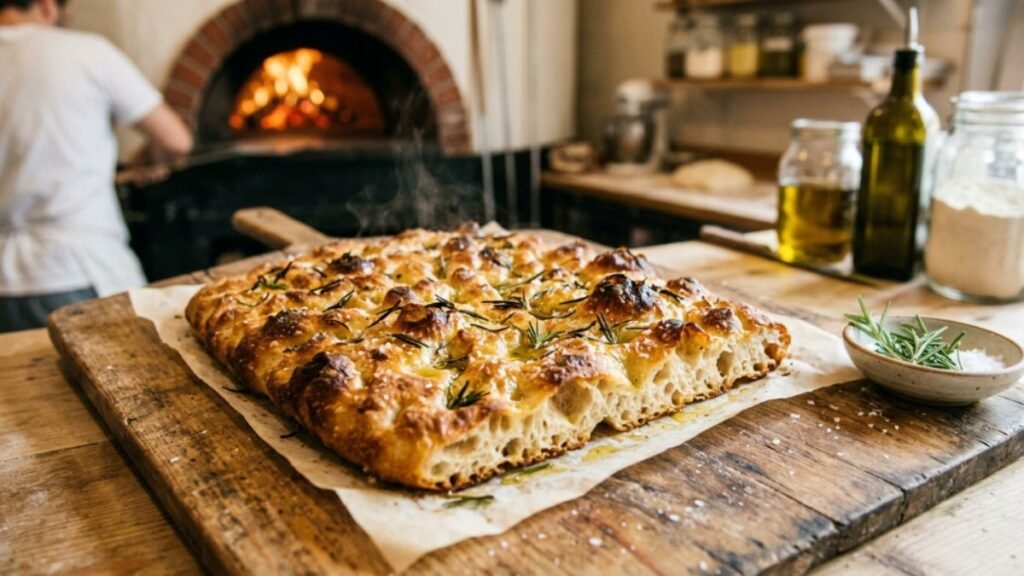
Preheat your oven to 450°F (230°C) for at least 30 minutes before baking. The oven must be at full temperature — placing focaccia in an insufficiently preheated oven produces a pale, soft crust rather than the golden, slightly crispy surface of the original.
Add the coarse sea salt to the surface immediately before placing in the oven. Pressing the salt gently into the dimples anchors it during baking.
Bake on the middle rack for 20 to 25 minutes. The focaccia is done when:
- The surface is deep golden brown — not pale gold, not dark brown
- The bottom crust, when lifted with a spatula, is golden and slightly crispy
- The internal temperature reaches approximately 200°F (93°C)
Remove from the oven and immediately slide the focaccia out of the pan onto a wire rack. Leaving it in the hot pan causes the bottom to steam and soften.
✓ Best Practice: Drizzle an additional tablespoon of extra virgin olive oil over the surface of the focaccia immediately after it comes out of the oven, while it is still hot. This finishes the flavor and adds a visible sheen to the surface. It is optional by strict recipe standards but unmistakably improves the final result.
Allow to cool for at least 10 minutes before cutting. Focaccia cut immediately from the oven compresses and loses its crumb structure.
Topping Variations: From Genovese Classic to Pugliese Style
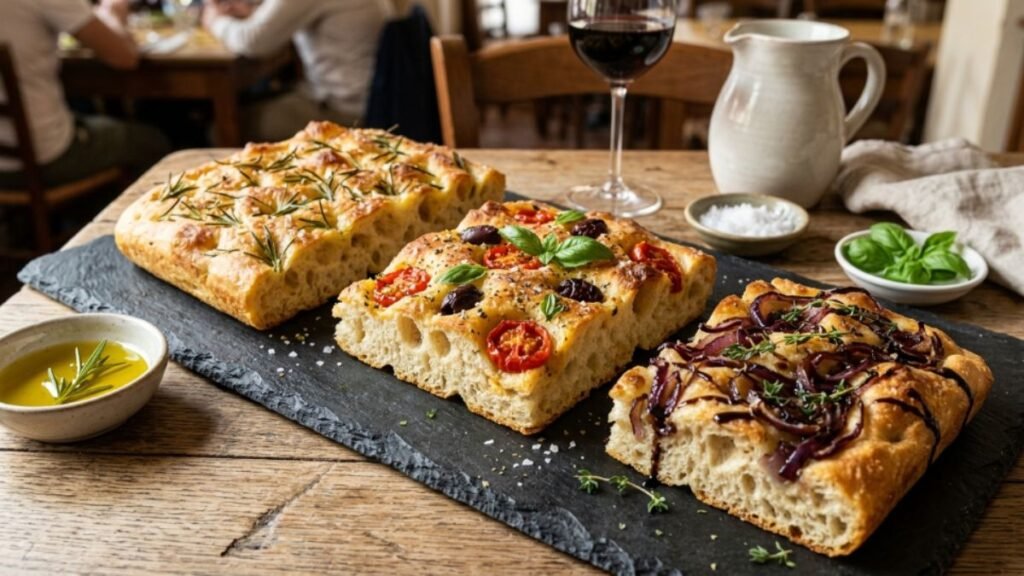
The plain Genovese version with sea salt is the starting point. These variations build on the same dough formula and technique.
Rosemary Focaccia
Press fresh rosemary leaves into the dimples before the final proof. The rosemary becomes slightly crispy and intensely fragrant in the oven. Use fresh rosemary only — dried rosemary burns before the bread finishes baking.
Focaccia Barese (Pugliese Style)
Press halved cherry tomatoes, pitted black olives, and dried oregano into the surface before baking. The tomatoes release their juice into the dimples during baking, creating small pools of concentrated tomato flavor. This is the version that connects most directly to The Gelato Route: Best Gelaterias in Italy.
Caramelized Onion Focaccia
Slowly cook thinly sliced white onions in olive oil over low heat for 30 to 40 minutes until deeply golden and sweet. Spread over the surface before the final proof. The sweetness of the onions against the salty, oily bread is a classic combination throughout Liguria and Piedmont.
Sage and Sea Salt
Press fresh sage leaves into the surface, brush lightly with additional olive oil, and finish with flaky salt. One of the quietest and most elegant variations — and one that pairs particularly well as an accompaniment to soups and braised dishes.
Serving Focaccia the Italian Way
In Liguria, focaccia is eaten at breakfast — torn and dipped into a cappuccino or accompanied by a glass of cold white wine in the more traditional morning rituals of older generations. It is eaten at lunch alongside cured meats and cheese. It is used as a sandwich bread, split horizontally and filled with mortadella or stracchino cheese.
The Italian approach to serving focaccia resists the formality of slicing it into neat squares with a bread knife. It is torn, stacked, folded, eaten standing. This informality is not laziness — it is an acknowledgment that focaccia is everyday food, not occasion food. Its purpose is nourishment and pleasure simultaneously, without ceremony.
For a broader understanding of how this bread connects to Italian cooking as a whole, our guide to Traditional Italian Pasta Recipes and the cultural depth behind dishes like the one covered in The History Behind Tiramisu provide useful context for how individual recipes fit into a larger culinary identity.
Conclusion
Authentic Italian focaccia is one of the most accessible and rewarding breads to make at home — it requires no shaping skill, no specialized equipment, and no experience beyond the patience to follow the proofing steps correctly. The reward is a bread with a flavor that no commercial product comes close to matching.
The four fundamentals to carry forward: use tipo 00 flour when possible, do not reduce the olive oil, proof the dough overnight in the refrigerator for best flavor, and bake in a fully preheated oven at high temperature. These decisions account for the difference between focaccia that is merely adequate and focaccia that makes someone stop eating mid-conversation to say something about it.
Make the plain Genovese version first. Master the dough, understand how it behaves during proofing, learn how it looks when it is ready for the oven. Once that version is reliable, every variation becomes a small, low-risk experiment on a foundation you understand. Save this recipe, share it with anyone who has ever been underwhelmed by the focaccia they have bought, and make it on a weekend morning when there is time to enjoy the process.
Frequently Asked Questions
Why is my focaccia dry and dense instead of soft?
The most common causes are insufficient olive oil (both in the dough and on the surface), under-proofing before baking, or an oven that was not hot enough. Authentic focaccia requires what initially seems like an alarming amount of olive oil — the full quantities in the recipe are not excessive. They are necessary. Also confirm your oven is calibrated correctly — many home ovens run 25 to 50°F cooler than indicated.
Can I make focaccia dough the day before?
Yes, and we strongly recommend it. After mixing, place the covered dough in the refrigerator immediately for an overnight cold proof of 8 to 16 hours. Remove 30 minutes before panning. Cold-proofed focaccia has a noticeably more complex flavor than same-day dough. It is one of the simplest improvements you can make to the recipe.
What flour works best if I cannot find tipo 00?
All-purpose flour (10 to 11% protein) is the most appropriate substitute and produces reliable results. Bread flour (12 to 14% protein) produces a chewier, more elastic crumb — acceptable but different from the Ligurian standard. Avoid whole wheat flour as a direct replacement — it absorbs water differently and produces a dense, heavy bread.
How do I get a crispier bottom crust?
Three factors control bottom crust crispiness: pan material (dark metal is best), olive oil quantity in the pan (be generous), and oven temperature (450°F minimum, fully preheated). If your bottom crust is consistently soft, try placing the pan on the oven’s lowest rack for the final 5 minutes of baking.
Can focaccia be frozen?
Yes. Cool completely, then cut into portions and wrap tightly in plastic wrap before placing in a freezer bag. Freeze for up to 2 months. Reheat directly from frozen in a 375°F (190°C) oven for 8 to 10 minutes. Frozen and reheated focaccia is not identical to fresh, but it is far better than day-old focaccia left at room temperature.
Is focaccia the same as pizza dough?
hey use similar ingredients but are not interchangeable. Focaccia dough typically has higher hydration (60–65% vs. 55–60% for pizza), more olive oil, and is proofed directly in the baking pan rather than stretched by hand. The result is softer, thicker, and more pillowy than pizza. Using focaccia dough to make pizza produces a thick-crust result — closer to Sicilian-style pizza than Neapolitan
What is the difference between focaccia and schiacciata?
Schiacciata is the Tuscan equivalent — thinner, less oily, and often crispier throughout. The word means “flattened” and describes the technique of pressing the dough very thin before baking. Focaccia genovese is thicker and has a defined, soft crumb. Schiacciata typically has a more uniform, cracker-adjacent texture. Both are excellent; they serve different purposes at the table.
[📷 IMAGE SUGGESTION: Final styled shot — square portion of focaccia on a white ceramic plate, surface glistening with olive oil, coarse salt crystals visible, a small dish of olive oil for dipping beside it, warm side lighting. Alt text: “Authentic Italian focaccia slice on white plate with olive oil for dipping”]

Mary Ciss is a food writer and Italian gastronomy enthusiast with a passion for authentic recipes, culinary history, and the stories behind every dish. Through Mio Gelatto, she explores the real flavors of Italy — from centuries-old gelato traditions to the hidden trattorias that locals love. For Mary, every recipe is a journey.