Seasonal Gelato Recipes with Fresh Fruit: An Italian Approach
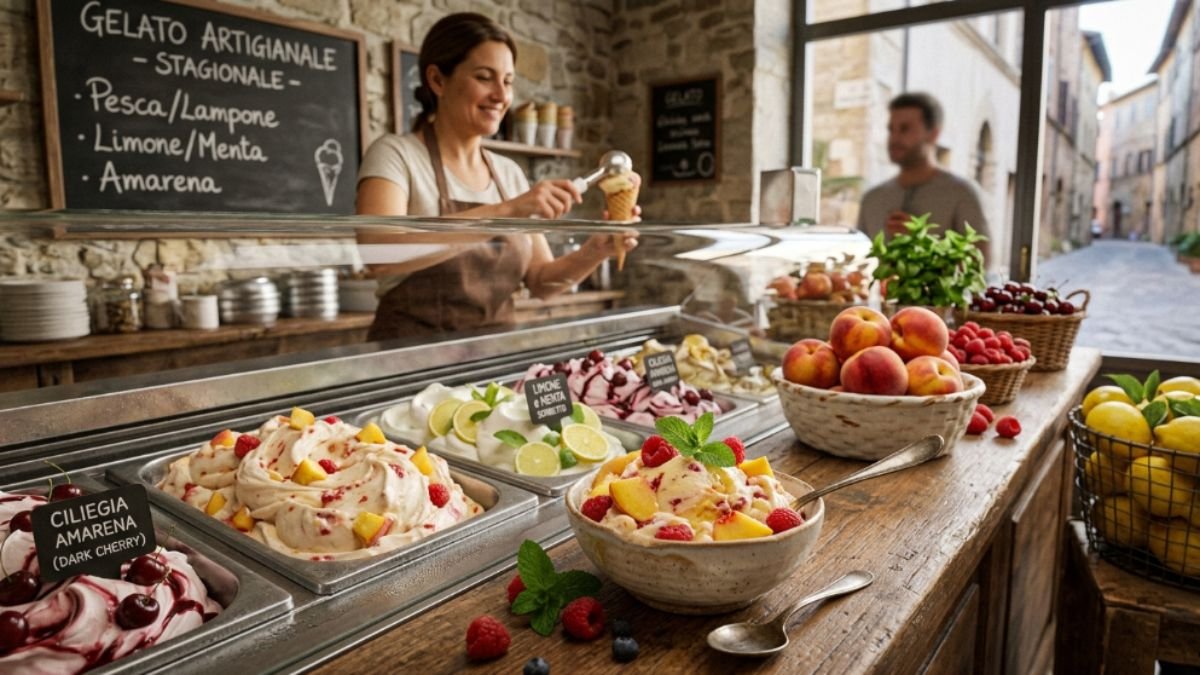
Seasonal Gelato Recipes with Fresh Fruit that come out of Italian artisan gelaterias every summer share one quality that most recipes overlook entirely: the fruit is not an ingredient — it is the point. In Italian gelato culture, a strawberry gelato made in June with peak-season local strawberries and the same gelato made in January with fruit transported from another hemisphere are not the same product.
They are different desserts. One is worth making. The other is not. That philosophy — fruit at its peak, nothing more, nothing less — is the foundation of everything we are going to cover in this guide.
Fresh fruit consumption in the United States has grown steadily over the past decade, with the USDA reporting that per capita fresh fruit availability increased by more than 12% between 2015 and 2023. American home cooks are buying better fruit, visiting farmers markets more frequently, and looking for ways to preserve and celebrate seasonal produce beyond simple eating.
Gelato is one of the most effective and elegant answers to that search — a format that concentrates and elevates the flavor of fresh fruit without obscuring it behind cream or sugar.
We have tested dozens of fruit-based gelato and sorbetto recipes across different seasons, working with both dairy-based milk gelato and fully dairy-free sorbetto bases to understand how different fruits behave when frozen. The discoveries were not always what we expected. Some fruits — strawberry, peach, blood orange — translate beautifully into gelato with minimal intervention.
Others require more careful handling: fig needs a small amount of honey to prevent iciness; watermelon needs aggressive straining to remove excess water; mango needs acid to balance its natural sweetness. These nuances are rarely covered in standard gelato recipes, and they are exactly what we will address here.
In this guide, you will find complete recipes for eight seasonal fruit gelatos and sorbettos, organized by season for practical use. You will also learn the technical principles that make fruit gelato work — how to handle water content, how to balance sugar ratios, and how to extract maximum flavor before the fruit ever touches a machine. By the end, you will have the framework to create your own fruit gelato recipes from whatever is at its peak in your local market.
Why Seasonality Is Non-Negotiable in Italian Fruit Gelato
The Italian approach to fruit gelato is rooted in a principle that predates modern food culture by centuries: you make food from what is available and at its best, not from what is available year-round. This is not nostalgia or affectation — it is a technical reality.
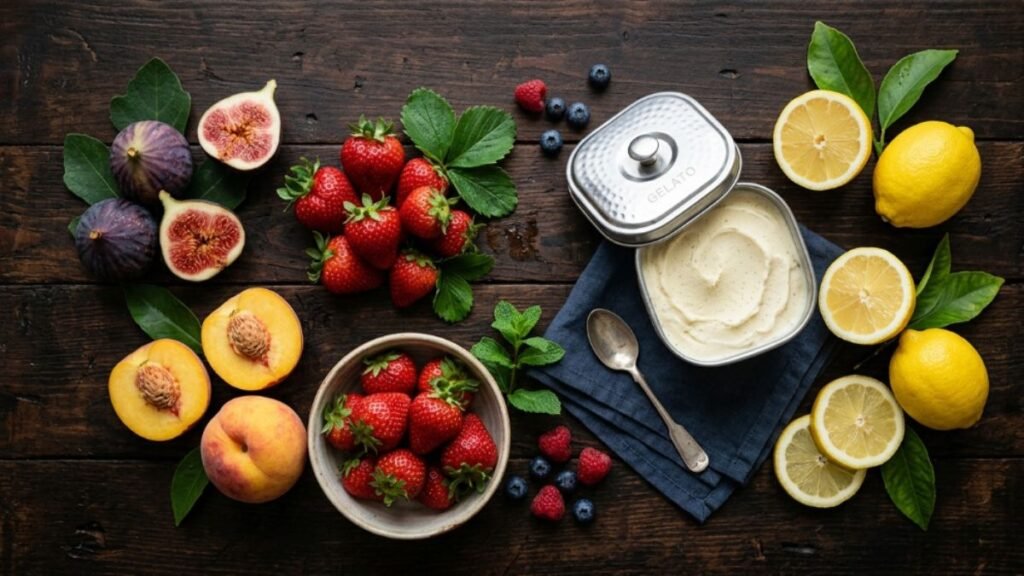
The flavor compounds responsible for the characteristic taste of a strawberry, a peach, or a fig are present in their highest concentrations at peak ripeness. A fruit picked early for transport and shelf life has a fraction of those compounds compared to one harvested at full maturity.
The flavor concentration effect
When you freeze fruit in a gelato or sorbetto base, you are not adding flavor — you are preserving and concentrating what is already there. If the fruit’s flavor is weak before freezing, it will be weaker after. If it is strong — the way a sun-ripened August peach or a perfectly ripe June strawberry is strong — it will be extraordinary.
This is why seasonal fruit gelato made with peak-season produce at an Italian gelateria is genuinely one of the most flavorful foods you will ever eat, and why the same dessert made in winter from out-of-season fruit is flat and forgettable.
The water content problem
Out-of-season and commercially grown fruit typically has a higher water content than fruit grown for flavor rather than shelf life. This matters enormously for gelato production. Excess water in the fruit base means more free water molecules in the mix, which means larger ice crystals during freezing, which means a coarser, icier texture.
Italian artisan gelato makers calibrate their sugar ratios — sugar lowers the freezing point and binds free water — based on the specific water content of each batch of fruit. Home cooks rarely do this, which is why many homemade fruit gelatos come out icier than expected.
💡 Practical Tip: Before making any fruit gelato, taste your fruit and rate its intensity on a scale from one to ten. If it scores below seven, add a small amount of fruit concentrate, good-quality jam, or macerated fruit to boost the flavor before proceeding. A base built on weak fruit will not improve in the freezer — it will only become a frozen version of something mild.
The Technical Foundation: Balancing Fruit, Sugar, and Water
Before presenting individual recipes, understanding the technical principles that govern fruit gelato production will make every recipe more reliable and give you the tools to adapt them independently. These are the same principles professional gelato makers apply — they are not complicated, but they make an enormous difference in the final result.
The sugar ratio for fruit gelato
Sugar serves two functions in fruit gelato: sweetness and texture. As a cryoscopic depressant — a substance that lowers the freezing point of a liquid — sugar determines how firm or soft the gelato becomes at a given temperature.
For fruit-based gelatos, the total sugar content (including the natural sugars already present in the fruit) should represent approximately 22% to 28% of the total weight of the base. Below 22%, the gelato freezes too hard. Above 28%, it remains perpetually soft and difficult to scoop cleanly.
The practical implication is that very sweet fruits — ripe mango, ripe fig, very ripe banana — require less added sugar than tart fruits like lemon, blood orange, or green apple. Many standard recipes ignore this variable and use a fixed sugar quantity regardless of the fruit’s natural sweetness, which is why they often produce results that are either too sweet or too icy.
Handling high-water fruits
Watermelon, cucumber, and certain varieties of melon contain 90% or more water by weight. Using these fruits in standard gelato quantities produces a base that is too dilute to freeze properly. The solution is to strain the fruit puree through a fine-mesh strainer, allow the juice to drain for 30 to 60 minutes, and use the thicker, more concentrated pulp rather than the total weight of the fruit. This simple step transforms a watery, crystalline result into a smooth, dense gelato with genuine flavor intensity.
Acid as a flavor tool
A small amount of acid — lemon juice, typically — brightens the flavor of almost any fruit gelato and helps balance natural sweetness. We add the juice of half a lemon to virtually every fruit-based recipe regardless of whether lemon is a flavor component.
The acid does not make the gelato taste lemony at these quantities; it makes whatever fruit you are using taste more like itself. This is the same principle that professional cooks apply when finishing savory dishes with a squeeze of citrus.
Seasonal Gelato Recipes: Spring and Early Summer Fruits
Spring and early summer bring some of the most celebrated fruit gelato flavors in the Italian tradition — strawberry above all, but also the first cherries and the distinctive fragoline di bosco (wild strawberries) that appear briefly in May and June across northern Italy.
Strawberry gelato — the benchmark of the season
Ingredients (serves 4–6):
- 500g (about 1 lb) fresh ripe strawberries, hulled
- 400ml (1 2/3 cups) whole milk
- 100ml (1/3 cup) heavy cream
- 150g (3/4 cup) granulated sugar
- Juice of 1/2 lemon
- Pinch of fine salt
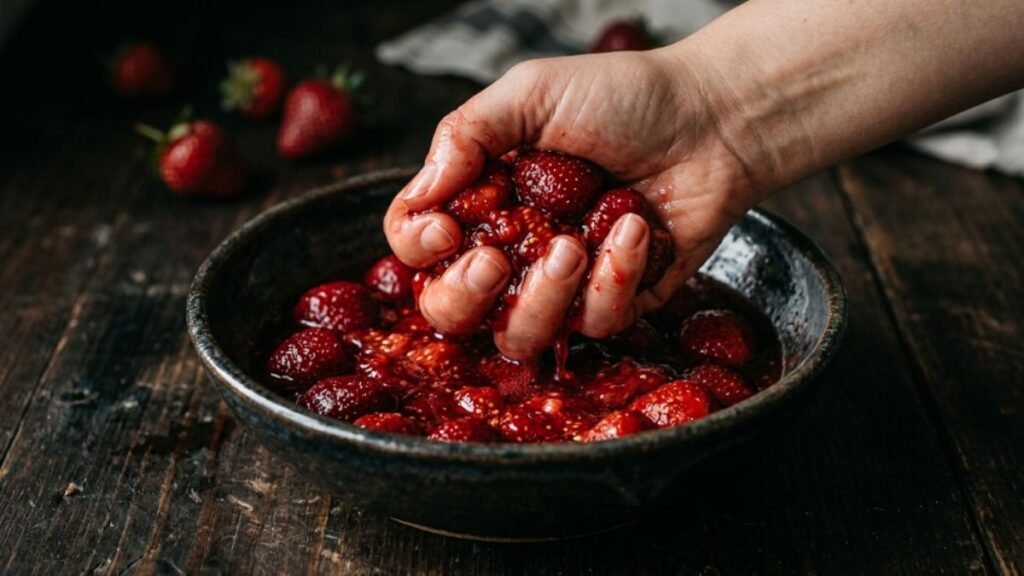
Hull and halve the strawberries. Toss with 50g of the sugar and allow to macerate at room temperature for 30 minutes — this draws out juice and intensifies the flavor through a process called osmotic maceration, one of the techniques professional gelato makers use that home recipes rarely mention. Blend the macerated strawberries with their juice until completely smooth.
Strain through a fine-mesh strainer to remove seeds. In a separate bowl, combine the milk, cream, remaining sugar, and salt; stir until the sugar dissolves completely. Combine the strawberry puree with the milk mixture, add the lemon juice, and chill for at least 4 hours. Churn and freeze according to your machine’s instructions, stopping 3 to 4 minutes earlier than you would for a plain milk gelato.
Sour cherry sorbetto — dairy-free intensity
Ingredients (serves 4):
- 600g (about 1.3 lb) fresh sour cherries, pitted
- 180g (just under 1 cup) granulated sugar
- 200ml (3/4 cup) water
- Juice of 1 lemon
Combine water and sugar in a saucepan; heat until completely dissolved into a simple syrup. Cool to room temperature. Blend the cherries to a smooth puree and strain through a fine-mesh strainer. Combine the cherry puree with the cooled syrup and lemon juice.
Chill for 4 hours and churn. Sour cherry sorbetto is one of the most intensely flavored frozen desserts you can make at home — the acidity of the cherries and the brightness of the lemon produce something that genuinely stops people mid-bite.
Seasonal Gelato Recipes: Peak Summer Fruits
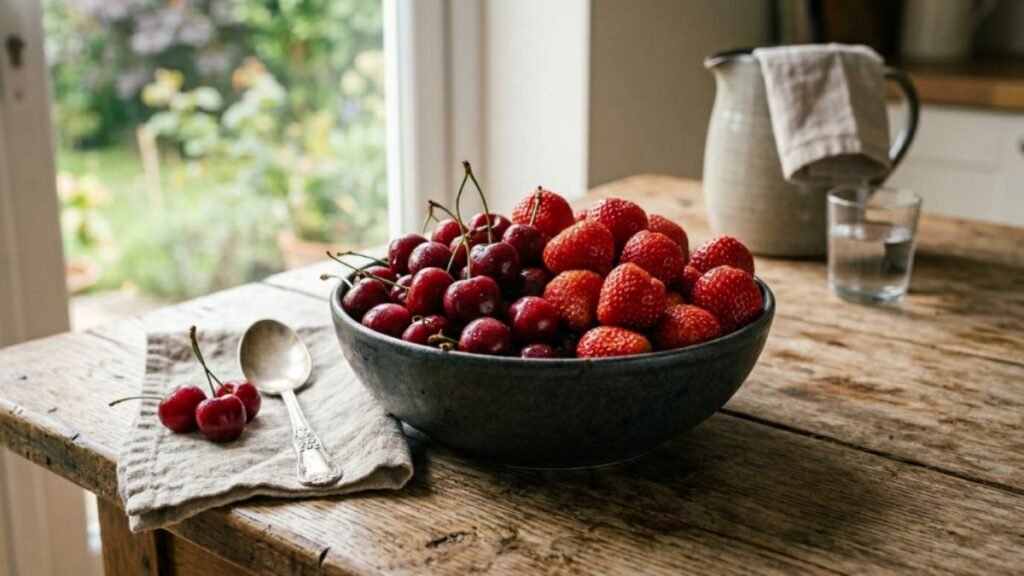
August is the month when Italian gelaterias reach their seasonal peak. Peaches, figs, blood peaches, and the first blackberries appear alongside the continuing run of strawberries and cherries. Each requires slightly different handling, but all reward the attention with flavors that are difficult to find in any other context.
White peach gelato — the queen of summer
Ingredients (serves 4–6):
- 600g (about 1.3 lb) ripe white peaches, peeled and pitted
- 350ml (1 1/2 cups) whole milk
- 80ml (1/3 cup) heavy cream
- 140g (2/3 cup) granulated sugar
- Juice of 1/2 lemon
- 1/2 teaspoon pure vanilla extract
White peaches — less common in American supermarkets but widely available at farmers markets in July and August — have a more delicate, aromatic flavor than yellow peaches and make a superior gelato. Peel by blanching in boiling water for 30 seconds, then transferring immediately to ice water — the skins slip off cleanly.
Blend the peeled peaches with a small amount of the sugar, strain, and proceed as with the strawberry recipe. The vanilla is not detectable as vanilla in the final product; it acts as a flavor enhancer that amplifies the peach without competing with it.
Fig and honey gelato — late summer luxury
Ingredients (serves 4):
- 400g (about 14 oz) very ripe fresh figs, stems removed
- 400ml (1 2/3 cups) whole milk
- 100ml (1/3 cup) heavy cream
- 80g (1/3 cup) granulated sugar
- 40g (2 tablespoons) good-quality honey — acacia or wildflower
- Juice of 1/2 lemon
Fig is one of the trickier fruits for gelato because of its high natural sugar content combined with relatively low water binding — it tends to produce icy results without the honey addition. The honey’s natural enzymes and hygroscopic properties (its ability to attract and hold water molecules) stabilize the base and produce a noticeably smoother texture. Use the ripest, softest figs available — if they are not soft enough to crush with gentle pressure, they are not ripe enough for gelato.
⚠️ Attention: Never use frozen fruit directly from the freezer as a substitute for fresh seasonal fruit in these recipes. Frozen fruit releases a significant amount of water as it thaws — often 20% to 30% of its weight — which throws off the water balance of the base entirely. If fresh fruit is unavailable, use a high-quality single-fruit puree specifically produced for gelato or pastry use, not consumer-grade frozen fruit.
Seasonal Gelato Recipes: Autumn and Citrus Season
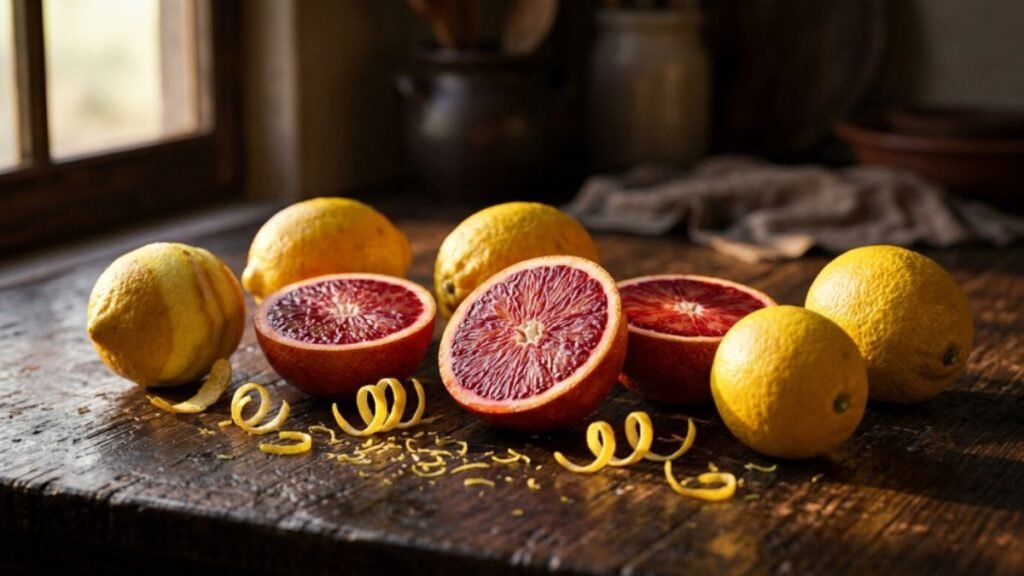
As summer fruit fades, autumn brings its own exceptional gelato ingredients — most notably the citrus season that begins in Sicily in October and runs through March. Blood oranges, clementines, and the extraordinary Amalfi lemon define the Italian winter gelato calendar.
Blood orange sorbetto — the color of Sicily
Ingredients (serves 4–6):
- 500ml (2 cups) fresh blood orange juice — approximately 8 to 10 blood oranges
- Zest of 2 blood oranges
- 200g (1 cup) granulated sugar
- 150ml (2/3 cup) water
- Juice of 1/2 lemon
Blood orange sorbetto is perhaps the most visually dramatic frozen dessert you can make at home — the color ranges from deep orange to vivid burgundy depending on the variety and season. Always juice blood oranges by hand rather than with an electric juicer; the machine extracts bitter compounds from the pith and membrane that affect the flavor significantly.
Make the simple syrup with water and sugar, cool completely, combine with the juice, zest, and lemon, chill for 4 hours, and churn. The result freezes at a slightly softer consistency than other sorbettos due to the natural acidity of blood orange — this is correct and desirable.
Lemon sorbetto — the Italian classic
Ingredients (serves 4):
- 250ml (1 cup) fresh lemon juice — approximately 6 to 8 lemons
- Zest of 3 lemons
- 200g (1 cup) granulated sugar
- 400ml (1 2/3 cups) water
Lemon sorbetto is the most technically demanding fruit recipe in this guide because the balance between acid and sweetness must be precise. Start with the ratio above and taste the base before churning — it should be noticeably tart, almost uncomfortably so when tasted as a liquid, because the cold of freezing mutes flavors significantly. If it tastes balanced or sweet before churning, it will taste flat and under-acidic as a sorbetto. The finished product should hit you with brightness first, then sweetness, then a long, clean finish.
Seasonal Fruit Gelato: Quick Reference by Season
| Season | Fruit | Base Type | Key Technique | Difficulty |
|---|---|---|---|---|
| Spring | Strawberry | Milk gelato | Macerate with sugar first | Beginner |
| Spring | Sour cherry | Sorbetto | Strain thoroughly | Beginner |
| Summer | White peach | Milk gelato | Blanch to peel, add vanilla | Beginner |
| Summer | Fig | Milk gelato | Add honey for stability | Intermediate |
| Summer | Watermelon | Sorbetto | Strain to remove excess water | Intermediate |
| Autumn | Blood orange | Sorbetto | Hand-juice only, add zest | Beginner |
| Autumn/Winter | Lemon | Sorbetto | Balance acid aggressively | Intermediate |
| Winter | Clementine | Sorbetto | Include zest for depth | Beginner |
✓ Best Practice: Make your gelato base the evening before you plan to churn it. A base that has rested in the refrigerator for 8 to 12 hours produces a measurably smoother result than one churned immediately after preparation. The resting period allows the sugars to fully dissolve and integrate with the liquid, and the thorough chilling means the machine has to do less work — which means less air incorporation and a denser, more authentic gelato texture.
SEE ALSO: The Gelato Route: Best Gelaterias in Italy and How to Visit Them
How to Adapt Any Fruit to a Gelato Recipe
Once you have made two or three of the recipes above, you will have developed an intuition for how fruit behaves in a frozen base. The following framework allows you to adapt virtually any fruit to a gelato or sorbetto recipe without starting from a published formula.
- Assess the fruit’s water content. High-water fruits (watermelon, cucumber, most melons) need straining before use. Medium-water fruits (peach, strawberry, cherry) can be blended and used directly. Low-water fruits (fig, banana, dried fruit) may need a small amount of additional liquid to achieve the right consistency.
- Taste and score the flavor intensity. Rate the fruit’s flavor on a scale of one to ten. Anything below seven needs reinforcement — maceration with sugar, a small amount of high-quality jam, or a brief reduction of the fruit juice to concentrate flavor.
- Calculate total sugar content. For every 1 kilogram of total base weight (fruit puree plus milk or water), aim for 220 to 260 grams of total sugar. Include the natural sugars already in the fruit — approximately 40 to 60 grams per 200g of most common fruits.
- Add acid regardless of fruit type. The juice of half a lemon per recipe brightens flavor and improves balance in virtually every fruit-based frozen dessert. Do not skip it even when lemon seems irrelevant to the flavor profile.
- Chill thoroughly before churning. At least 4 hours in the refrigerator, ideally overnight. A well-chilled base is the single most underrated step in home gelato production.
The Season Is the Recipe
The most important thing this guide can leave you with is a shift in how you think about fruit gelato recipes. The recipe is the framework; the season is the ingredient. A strawberry gelato recipe made in June with local, sun-ripened berries and the same recipe made in December with imported, out-of-season fruit are not the same dessert. One is worth making; the other is an exercise in disappointment.
The key takeaways: taste your fruit before you start — if it is not intensely flavored, the gelato will not be either. Use the maceration technique for berries and stone fruits to amplify natural flavor before freezing.
Balance your sugar ratios based on the sweetness of the specific fruit batch rather than following fixed quantities blindly. And always, always chill the base overnight before churning — it is the easiest improvement you can make and the one most home recipes ignore.
The Italian approach to seasonal gelato recipes with fresh fruit is not complicated. It asks only that you pay attention to what is available, choose the best of it, and treat it with enough respect to let it speak for itself in the final bowl. Follow that principle and the rest follows naturally.
Frequently Asked Questions About Gelato Recipes with Fresh Fruit
Can I use frozen fruit for gelato recipes?
We strongly discourage it for the recipes in this guide. Frozen fruit releases 20 to 30% of its weight as water when it thaws, which throws off the sugar and water balance of the base and produces a coarser, icier result. If fresh seasonal fruit is unavailable, use single-fruit purees produced for professional gelato or pastry use — these are available online and in specialty food stores and behave more predictably than frozen consumer fruit. The quality and flavor of the finished gelato will be noticeably different from a fresh-fruit version, but the texture will at least be correct.
How much fresh fruit do I need per batch of gelato?
For a batch serving 4 to 6 people, you typically need 400 to 600 grams of fresh fruit for milk-based gelato, or 500 to 700 grams for a dairy-free sorbetto. These are guidelines rather than fixed rules — the right quantity depends on the water content and flavor intensity of the specific fruit. The total base volume for a home batch is usually 700ml to 1 liter, and the fruit should represent 40% to 60% of that volume for most recipes.
Why does my fruit gelato turn icy after one day in the freezer?
Iciness in fruit gelato almost always indicates one of three problems: insufficient sugar to lower the freezing point adequately, too much water from the fruit relative to the total base, or storage at too low a temperature. Try increasing your sugar by 10% to 15%, strain high-water fruits more aggressively before use, and store your gelato at 10°F to 14°F (-12 to -10°C) rather than at standard freezer temperature. Pressing plastic wrap directly onto the surface before covering with a lid also reduces ice crystal formation significantly.
Can I make fruit gelato without a machine?
Yes. Use the still-freezing method: pour the prepared base into a shallow metal container and place in the freezer. Every 30 minutes for the first 2 to 3 hours, remove and stir vigorously with a fork or whisk, breaking up ice crystals as they form. The result is slightly less smooth than machine-churned gelato but perfectly acceptable — especially for sorbetto, which tolerates the method better than dairy-based gelato due to its simpler composition.
How long does fresh fruit gelato last in the freezer?
Fruit gelato is at its best within the first 24 to 72 hours. After 3 to 5 days, ice crystal formation becomes increasingly noticeable and the fresh fruit character begins to fade. Plan batch sizes that you will consume within 3 days — this is not a limitation but a feature of making gelato with real, fresh ingredients rather than stabilizers. If you want longer shelf life, a small addition of light corn syrup or glucose syrup (replacing 20% of the sugar) slows ice crystal formation without significantly affecting flavor.
Is fruit sorbetto healthier than milk-based fruit gelato?
Sorbetto contains no dairy fat and is generally lower in calories than milk-based gelato — a typical serving of lemon sorbetto contains approximately 120 to 150 calories, compared to 170 to 220 for a milk-based strawberry gelato of the same size. Both are significantly lower in calories and fat than American ice cream. However, sorbetto is not a low-sugar food — the sugar content is comparable to or higher than milk-based gelato, as sugar serves the additional function of texture management in the absence of dairy fat. For specific dietary guidance, consult a qualified nutritionist.
What is the difference between fruit gelato and fruit sorbet?
Fruit gelato uses a milk or cream base with fruit as the primary flavor ingredient — the dairy provides richness and rounds the acidity of the fruit. Fruit sorbetto (sorbet) uses no dairy at all — it is pure fruit, sugar, and water, which produces a more intense, cleaner fruit flavor at the cost of body and richness. Both are legitimate Italian frozen dessert formats; which is better depends entirely on the fruit and the context. High-acid fruits like lemon and blood orange are often better as sorbetto; stone fruits like peach and cherry work beautifully as both.

Mary Ciss is a food writer and Italian gastronomy enthusiast with a passion for authentic recipes, culinary history, and the stories behind every dish. Through Mio Gelatto, she explores the real flavors of Italy — from centuries-old gelato traditions to the hidden trattorias that locals love. For Mary, every recipe is a journey.