

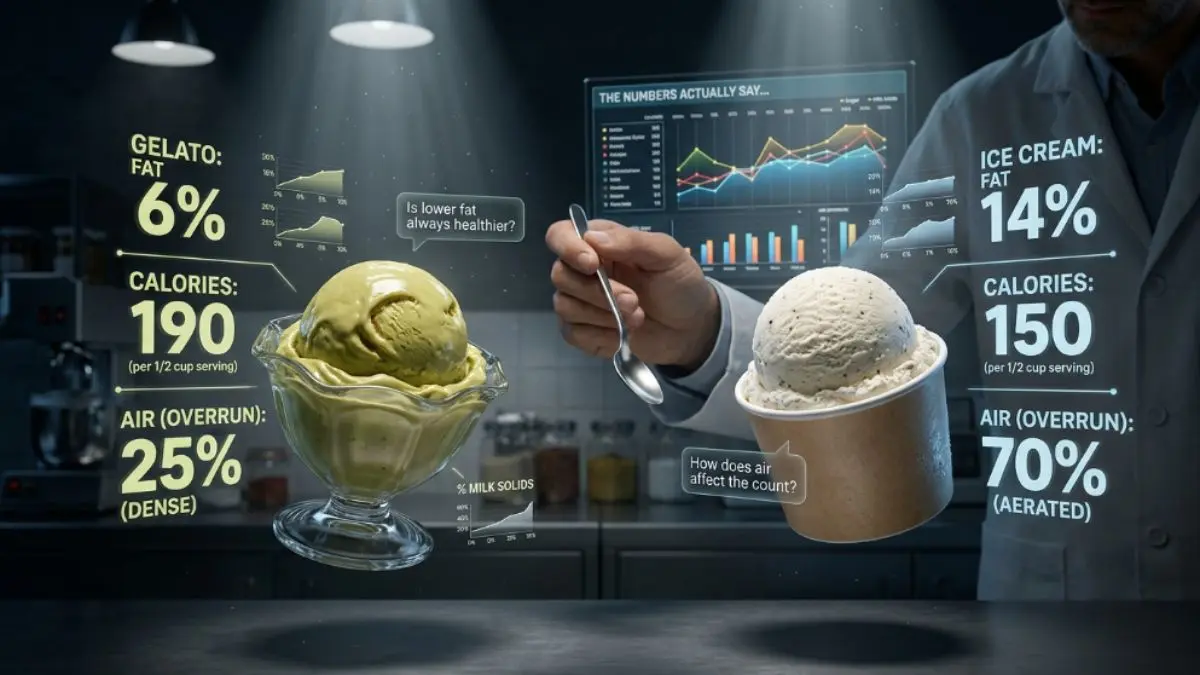
Is Gelato Healthier Than Ice Cream? What the Numbers Actually Say
Is Gelato Healthier Than Ice Cream? This question comes up every time someone stands in front of a gelateria counter and tries to justify their choice with nutritional logic. It is a reasonable question — the two desserts look similar, taste superficially related, and occupy the same category in most people’s minds. But when you examine the actual numbers rather than the assumptions, a more nuanced picture emerges. Gelato is not simply a healthier version of ice cream. It is a different product, made from different ingredients in different proportions, with different nutritional implications depending on what specifically you are comparing.
Frozen dessert consumption in the United States is substantial by any measure. The International Dairy Foods Association reports that Americans consume approximately 1.4 billion gallons of ice cream and frozen desserts each year — roughly 4 gallons per person annually.
As consumer interest in better-quality, lower-fat food options has grown, gelato’s market share in the United States has expanded significantly, with artisan gelato shop openings increasing by more than 30% between 2018 and 2024. Part of that growth is driven by the perception that gelato is a healthier choice — a perception that is partly accurate and partly oversimplified.
We have examined the nutritional data on both products carefully, comparing authentic artisan gelato against standard American ice cream across multiple dimensions — calories, fat content, sugar, protein, and ingredient quality. What we found confirmed some common assumptions and challenged others. Gelato does have meaningful nutritional advantages over ice cream in certain respects. In others, the differences are smaller than most people expect, and in a few cases, ice cream is the better option depending on what you are optimizing for.
In this article, you will get a clear, honest comparison of gelato and ice cream based on nutritional data rather than marketing claims. You will understand what makes them different at the ingredient level, how those differences translate into specific nutritional outcomes, and what those outcomes actually mean for someone making a thoughtful dessert choice.
Disclaimer: This content is for informational purposes only and does not replace professional medical advice. The nutritional information presented reflects general averages and may vary significantly between specific products and brands. Always consult a qualified healthcare professional or registered dietitian for personal dietary guidance.
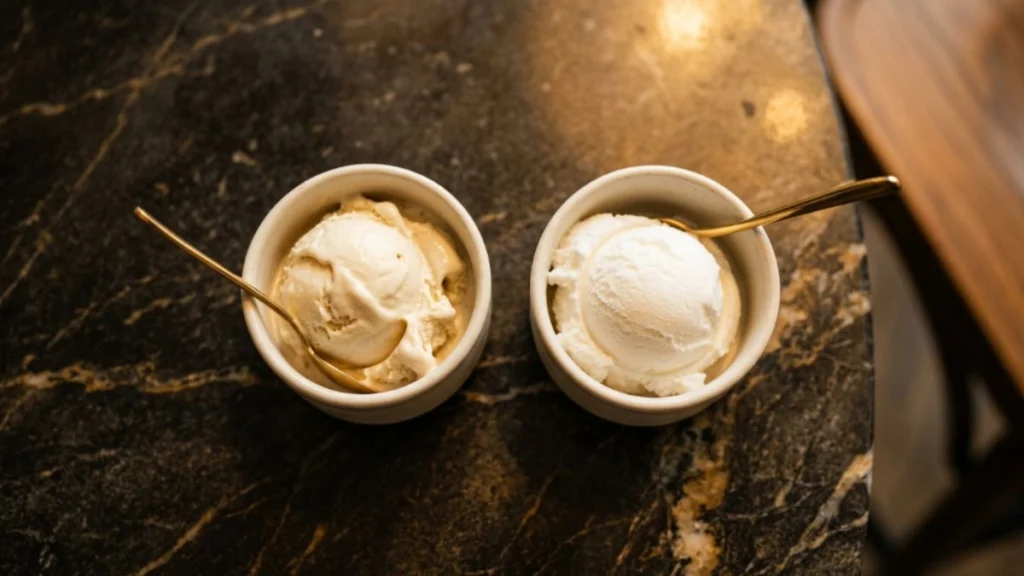
The Core Difference: What Gelato and Ice Cream Are Actually Made Of
Before comparing nutritional numbers, understanding the ingredient differences between authentic Italian gelato and standard American ice cream is essential. These differences are not superficial — they are fundamental to how each product is made, and they determine everything that follows nutritionally.
The dairy base
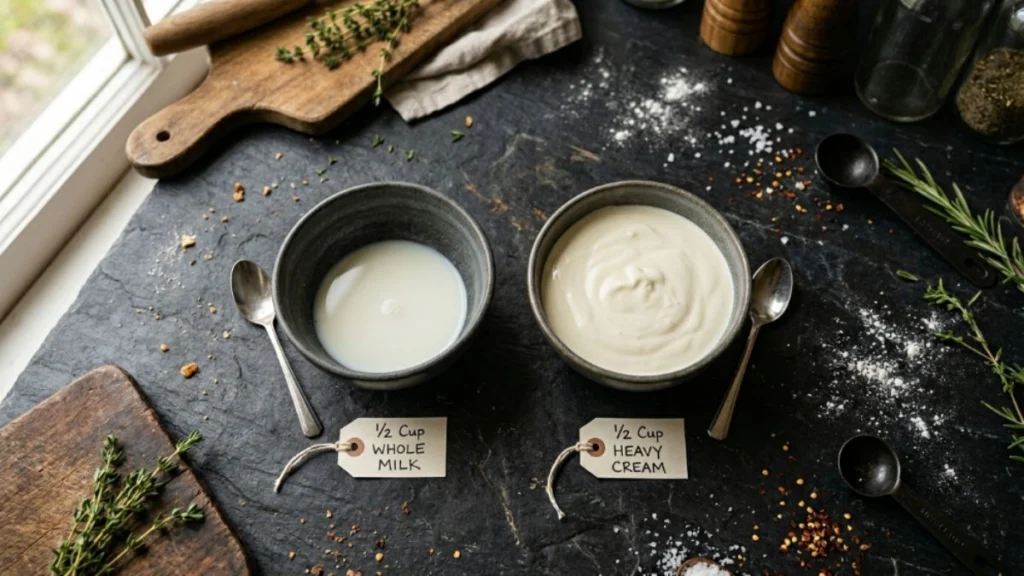
American ice cream uses heavy cream as its primary dairy component, which contains approximately 36% to 40% milkfat. This gives ice cream its characteristic richness and smooth texture at cold temperatures. Authentic Italian gelato uses whole milk as its primary dairy component, with cream added in much smaller quantities or not at all.
Whole milk contains approximately 3.5% milkfat — a fraction of the cream content in ice cream. This single ingredient difference is responsible for the most significant nutritional distinction between the two products.
The air factor
Both gelato and ice cream are churned — air is incorporated during the freezing process. But the amount of air differs dramatically. American ice cream is churned aggressively, incorporating 50% to 100% air by volume — a measure called overrun.
This means a pint of standard ice cream is 50% to 100% air by volume. Authentic gelato is churned slowly and gently, keeping overrun between 20% and 35%. A pint of gelato therefore weighs significantly more than a pint of ice cream of equal volume, and contains proportionally more actual food per serving.
Eggs and stabilizers
Many American ice cream formulas — particularly commercial brands — include egg yolks, which add richness and calories, along with a range of stabilizers, emulsifiers, and artificial flavorings that extend shelf life and maintain consistency across industrial production scales.
Authentic artisan gelato typically uses no artificial stabilizers, no artificial flavorings, and no artificial colorings. The cleaner ingredient list of genuine artisan gelato is one of its genuine advantages over commercial ice cream, though it comes with a shorter shelf life and more variable texture depending on storage conditions.
Calories: The Number Everyone Wants First
Calorie comparison is where most gelato-versus-ice-cream discussions begin, and it is also where the most misunderstanding occurs. The reason is that calorie comparisons depend heavily on serving size, and the serving sizes for gelato and ice cream are rarely the same in practice.
Per-gram calorie content
On a per-gram basis, authentic artisan gelato contains approximately 150 to 200 calories per 100 grams. Standard American ice cream (full-fat, vanilla, from a major commercial brand) contains approximately 200 to 250 calories per 100 grams. The difference is real — roughly 20% to 25% fewer calories per gram in gelato — and it is almost entirely explained by the lower fat content of the milk-based gelato versus the cream-based ice cream.
The serving size complication
Here is where the comparison becomes more complicated. Because gelato is denser than ice cream — less air per unit of volume — a standard scoop of gelato weighs more than a standard scoop of ice cream of the same apparent size.
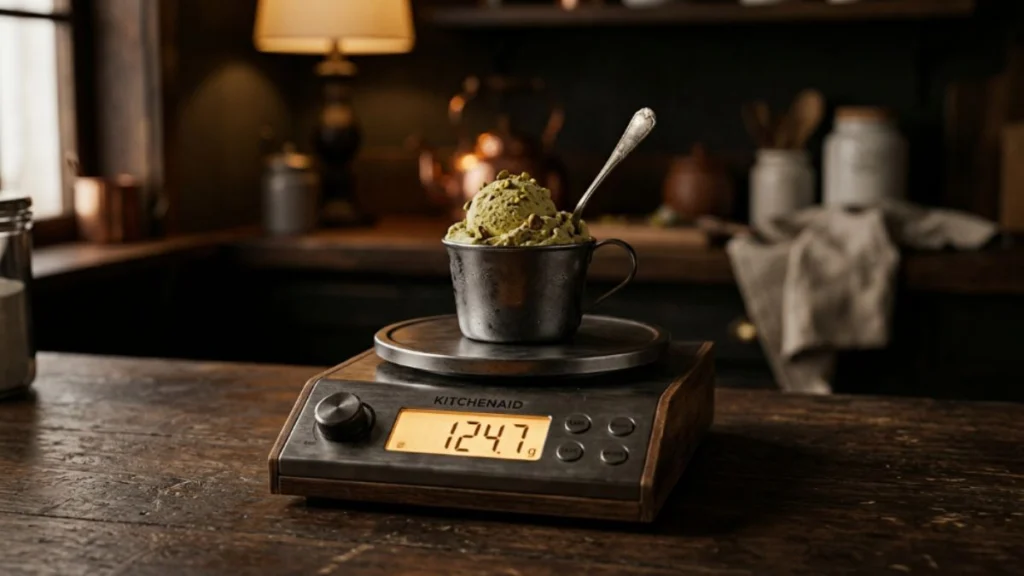
A 100-gram serving of gelato and a 100-gram serving of ice cream look noticeably different in a cup. The gelato serving is smaller visually. This means that people who judge portion size by appearance rather than weight may inadvertently consume a larger caloric serving of gelato than they intended, simply because they fill the cup to the same visual level they would with ice cream.
The practical verdict on calories
Per gram, gelato has fewer calories than ice cream. Per visual serving, the difference is smaller than most people expect. If you are genuinely tracking calorie intake, weigh your serving rather than estimating by eye — this applies to both products. A 75-gram serving of gelato is roughly equivalent in calories to a 100-gram serving of standard American ice cream.
Fat Content: Where the Real Difference Lives
Fat content is the most significant nutritional distinction between authentic gelato and American ice cream, and it is the area where gelato’s advantage is most consistent and most meaningful.
The numbers
Authentic artisan gelato contains 4% to 8% fat by weight — derived primarily from whole milk, with minimal cream addition. Standard American ice cream must legally contain a minimum of 10% milkfat to be labeled ice cream in the United States, and many popular brands contain 12% to 16% or more. Premium ice cream brands — those marketed as especially rich and creamy — often exceed 18% fat.
In practical terms, a 100-gram serving of gelato contains approximately 4 to 8 grams of fat. The same serving of standard American ice cream contains 10 to 16 grams of fat. Premium ice cream can reach 18 to 22 grams per 100-gram serving.
For someone monitoring saturated fat intake — as recommended by the American Heart Association, which suggests limiting saturated fat to less than 13 grams per day for a standard 2,000-calorie diet — this distinction is meaningful.
Saturated fat specifically
Dairy fat is predominantly saturated fat. Both gelato and ice cream derive their fat from dairy, so both contribute saturated fat to the diet. Gelato contributes substantially less — approximately 2.5 to 5 grams of saturated fat per 100-gram serving compared to 6 to 10 grams for standard ice cream.
For individuals with cardiovascular health concerns, this difference is worth understanding, though it does not make gelato a heart-healthy food by any definition.
Attention: The fat content advantage of gelato over ice cream applies specifically to authentic artisan gelato made with whole milk as the primary base. Many products sold in the United States as "gelato" are made with cream-heavy bases that are nutritionally indistinguishable from premium ice cream. Always check the ingredient list — if cream is the first ingredient listed before milk, the product's fat content is likely comparable to ice cream regardless of what it is called.
Sugar Content: The Area Where Gelato Offers No Advantage
Sugar is where gelato’s health narrative becomes more complicated — and where honest comparison requires acknowledging an inconvenient truth. Gelato is not a low-sugar food, and in some cases it contains more sugar per serving than equivalent ice cream products.
Why gelato needs more sugar
Sugar in gelato serves a functional role beyond sweetness. As a cryoscopic depressant — a substance that lowers the freezing point of a mixture — sugar is what keeps gelato soft and scoopable at freezer temperatures.
Because gelato is stored at a slightly warmer temperature than ice cream and has less fat to contribute to its texture and structure, it typically requires a higher sugar concentration to maintain proper consistency. The total sugar content of authentic artisan gelato typically falls between 18% and 25% of the total base weight.
The comparison numbers
A 100-gram serving of standard American vanilla ice cream contains approximately 20 to 24 grams of sugar. A 100-gram serving of artisan gelato contains approximately 22 to 28 grams of sugar. The difference is small and varies considerably by flavor and producer, but the pattern is consistent: gelato’s lower fat content is not accompanied by lower sugar content.
For individuals managing blood sugar levels or following low-sugar dietary approaches, this is a critical piece of information that most gelato marketing omits entirely.

Complete Nutritional Comparison: Gelato vs Ice Cream vs Sorbet
| Nutritional Factor | Artisan Gelato | Standard Ice Cream | Premium Ice Cream | Fruit Sorbetto |
|---|---|---|---|---|
| Calories per 100g | 150–200 kcal | 200–250 kcal | 250–300 kcal | 100–140 kcal |
| Total fat per 100g | 4–8g | 10–16g | 16–22g | 0g |
| Saturated fat per 100g | 2.5–5g | 6–10g | 10–14g | 0g |
| Sugar per 100g | 22–28g | 20–24g | 20–26g | 24–32g |
| Protein per 100g | 3–5g | 3–4g | 3–4g | 0–1g |
| Artificial additives | None (artisan) | Often present | Often present | None (artisan) |
| Dairy-free option | Sorbetto only | Not standard | Not standard | Yes — always |
Medical Disclaimer: The information provided in this article is for educational purposes only and is not intended to serve as medical advice, diagnosis, or treatment. Nutritional values represent general averages across commercially available and artisan products and may vary significantly between individual producers, brands, and recipes. Results and dietary impacts may vary from person to person. If you have medical conditions — including diabetes, cardiovascular disease, lactose intolerance, or other conditions affected by fat, sugar, or dairy intake — are taking medications, or have specific health concerns related to frozen dessert consumption, consult a licensed healthcare professional or registered dietitian before making dietary decisions based on this content.
Ingredient Quality: The Advantage That Numbers Cannot Fully Capture
Nutritional data captures macronutrients — calories, fat, sugar, protein. It does not capture ingredient quality, and in the comparison between authentic artisan gelato and commercial ice cream, ingredient quality is arguably the most meaningful distinction of all.
What artisan gelato contains
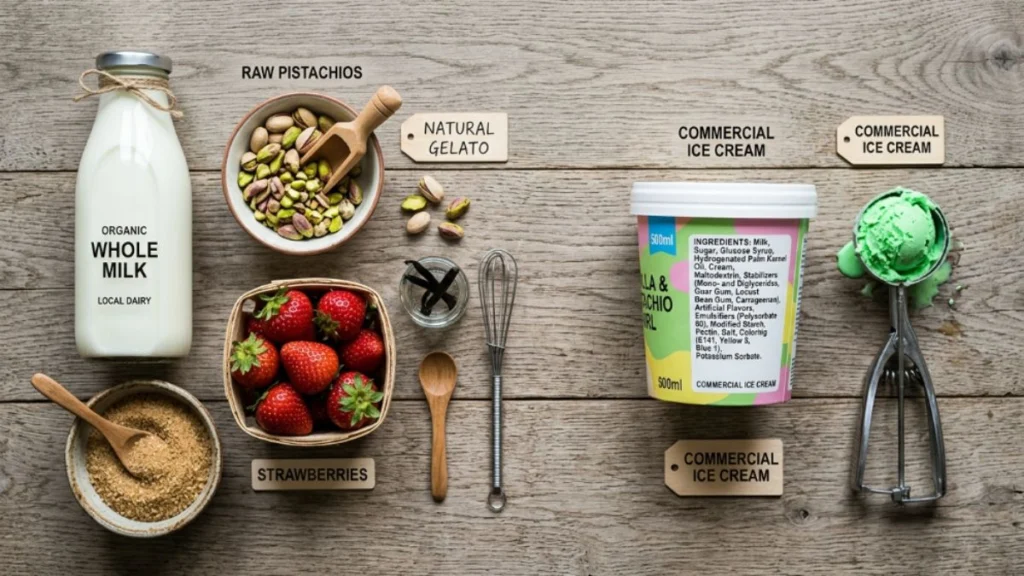
Authentic artisan gelato — the kind produced by a gelateria committed to traditional methods — contains whole milk, sometimes a small amount of cream, sugar, and pure flavor ingredients: real pistachio paste, fresh strawberries, genuine espresso, actual lemon zest. The ingredient list is short and recognizable. No carrageenan, no guar gum, no sodium alginate, no mono and diglycerides, no artificial flavors, no artificial colors.
What commercial ice cream often contains
The ingredient list of a standard commercial American ice cream brand is frequently much longer. Common additions include carrageenan (a seaweed-derived thickener linked in some research to gastrointestinal inflammation, though its safety at standard consumption levels is generally considered acceptable by the FDA), various emulsifiers, natural and artificial flavor compounds, and in many lower-cost products, significant amounts of artificial coloring.
These additives serve legitimate functional purposes in industrial production — they extend shelf life, maintain consistency across batches, and prevent the texture degradation that occurs with temperature fluctuations during transport and storage — but they are not present in artisan gelato.
The real-food argument
From a whole-food perspective — the principle that foods with fewer, more recognizable ingredients are generally preferable to those with more complex additive profiles — authentic artisan gelato has a clear advantage over commercial ice cream. This advantage is not captured in standard nutritional data but is meaningful to consumers who prioritize ingredient transparency and minimal processing.
Protein and Micronutrients: A Small but Real Difference
Gelato’s higher milk content — relative to ice cream’s cream content — gives it a modest but measurable advantage in protein and certain micronutrients. Milk contains more protein per gram than cream, more calcium, and more of the B vitamins associated with dairy nutrition. A 100-gram serving of authentic artisan gelato typically provides 3 to 5 grams of protein compared to 3 to 4 grams for standard ice cream of the same weight.
The difference is not large enough to make gelato a meaningful protein source in any dietary context — it is a dessert, not a protein supplement. But for individuals who consume frozen desserts regularly, the incremental difference in protein and calcium content from milk-based gelato versus cream-based ice cream accumulates over time. This is a minor advantage, honestly reported, not a health claim.

Gelato for Specific Dietary Needs: Lactose, Dairy-Free, and Lower-Calorie Options
Beyond the standard gelato-versus-ice-cream comparison, many consumers have specific dietary requirements that affect which frozen dessert is appropriate for them. Understanding how gelato’s format accommodates — or does not accommodate — different dietary needs is practically useful.
Lactose intolerance
Both gelato and ice cream contain lactose, the natural sugar found in milk and cream. Because gelato uses a higher proportion of milk and less cream than ice cream, and because milk contains slightly more lactose than cream per gram of fat, gelato may cause more discomfort than ice cream for individuals with lactose intolerance — contrary to what some sources suggest. The best option for lactose-intolerant consumers within the Italian frozen dessert tradition is sorbetto, which is entirely dairy-free.
Dairy-free and vegan options
Italian sorbetto is naturally dairy-free and vegan — made from water, sugar, and fruit with no animal products. It is also the lowest-calorie option in the Italian frozen dessert tradition, with approximately 100 to 140 calories per 100-gram serving. For consumers avoiding dairy entirely, sorbetto is the most authentic Italian option and one of the most nutritionally straightforward frozen desserts available.
Lower-calorie frozen dessert choices
- Fruit sorbetto (0% fat, 100–140 calories per 100g) — the lowest-calorie authentic option in Italian frozen dessert culture, with intense flavor from real fruit and no dairy
- Granita (0% fat, 80–120 calories per 100g) — even lower in calories than sorbetto, coarser texture, traditional Sicilian preparation using water, sugar, and fresh fruit or espresso
- Artisan gelato (4–8% fat, 150–200 calories per 100g) — lower in calories and fat than ice cream, more satisfying per gram due to density
- Standard American ice cream (10–16% fat, 200–250 calories per 100g) — highest in fat and calories among the comparison group, but widely available and familiar
The Honest Answer to an Honest Question
Is gelato healthier than ice cream? The honest answer is: it depends on what you mean by healthier, and it depends on which gelato and which ice cream you are comparing.
Authentic artisan gelato has fewer calories per gram than standard American ice cream, significantly less fat, and a cleaner ingredient profile with no artificial additives. These are genuine advantages for someone making a thoughtful comparison. At the same time, gelato is not a low-sugar food, it is not appropriate for people with lactose intolerance, and the calorie advantage largely disappears when you account for serving density.
The key takeaways: the fat content difference between authentic gelato and standard ice cream is real and meaningful — roughly half the fat per gram. The calorie difference exists but is smaller than most people expect and depends on serving size. The sugar content is comparable between the two.
The ingredient quality of artisan gelato — no artificial additives, no stabilizers, no artificial colors — is a genuine advantage over commercial ice cream that nutritional data does not fully capture. And sorbetto, the dairy-free member of the Italian frozen dessert family, offers the lowest calorie and fat option of all with no sacrifice in authentic flavor.
Gelato is a dessert. Its primary value is pleasure — the pleasure of a dense, silky, intensely flavored product made from real ingredients with centuries of craft behind it. That it also happens to compare favorably to ice cream on several nutritional dimensions is a welcome bonus. Enjoy it with that context, in appropriate portions, and the numbers will take care of themselves.
SEE ALSO: The Gelato Route: Best Gelaterias in Italy and How to Visit Them
Frequently Asked Questions: Is Gelato Healthier Than Ice Cream?
Is gelato lower in calories than ice cream?
On a per-gram basis, authentic artisan gelato typically contains 150 to 200 calories per 100 grams, compared to 200 to 250 calories for standard American ice cream. That represents approximately a 20% to 25% calorie reduction per gram. However, because gelato is denser than ice cream — it contains less air — visual serving sizes can be misleading. A cup filled to the same level with gelato versus ice cream will contain more calories of gelato than ice cream. For accurate comparison, weigh servings rather than estimating by eye.
Does gelato have less fat than ice cream?
Yes — this is the most consistent nutritional difference between the two. Authentic artisan gelato contains 4% to 8% fat from its whole-milk base. American ice cream must contain at least 10% milkfat by law and commonly contains 12% to 16%. Premium ice creams can reach 18% to 22% fat. For individuals monitoring saturated fat intake, this distinction is meaningful. The advantage applies specifically to genuine artisan gelato — products sold as gelato in the United States are not required to meet any specific fat content standard.
Is gelato high in sugar?
Yes. Gelato is not a low-sugar food. A 100-gram serving of artisan gelato typically contains 22 to 28 grams of sugar — comparable to or slightly higher than standard American ice cream at 20 to 24 grams. Sugar serves a functional role in gelato beyond sweetness, acting as a cryoscopic depressant that keeps the product soft and scoopable at freezer temperatures. For individuals managing blood sugar levels, the sugar content of gelato is comparable to ice cream and should be considered accordingly.
Is gelato safe for people with lactose intolerance?
Not reliably. Both gelato and ice cream contain lactose. Gelato’s higher milk content relative to cream may actually result in slightly more lactose per serving than cream-heavy ice cream, contrary to some popular claims. The genuinely dairy-free option within Italian frozen dessert culture is sorbetto — made entirely from water, sugar, and fruit with no dairy content — which is both lactose-free and vegan.
Is gelato a good choice for people trying to lose weight?
Gelato has fewer calories and less fat per gram than ice cream, which may make it a marginally better choice for individuals managing caloric intake who want to include a frozen dessert in their diet. However, it is still a sugar-dense food and should be treated as an occasional pleasure rather than a dietary staple. Portion size matters significantly — a small serving of gelato thoughtfully enjoyed is nutritionally preferable to a large serving consumed quickly. For personalized dietary guidance, consult a registered dietitian.
Is sorbet healthier than both gelato and ice cream?
On most standard nutritional measures, yes. Fruit sorbetto contains zero fat, approximately 100 to 140 calories per 100 grams, and no dairy. It is the lowest-calorie option in the Italian frozen dessert family and is naturally suitable for vegan and dairy-free diets. However, sorbetto typically has a higher sugar content than either gelato or ice cream — sugar is essential for its texture in the absence of fat — so it is not appropriate for individuals specifically limiting sugar intake. It is the best choice for those prioritizing low fat and low calories over low sugar.
How do I know if a gelato is authentic versus industrial?
The most reliable indicator is the ingredient list. Authentic artisan gelato contains whole milk, possibly a small amount of cream, sugar, and pure flavor ingredients — the list is short and recognizable. Industrial gelato products often contain stabilizers, emulsifiers, artificial flavors, and artificial colors. Physically, authentic gelato is stored in covered metal pozzetti containers at a warmer temperature than ice cream; industrial product is often displayed in open tubs piled high above the rim. The color of authentic gelato is always natural and muted — vivid artificial colors indicate artificial flavoring

Mary Ciss is a food writer and Italian gastronomy enthusiast with a passion for authentic recipes, culinary history, and the stories behind every dish. Through Mio Gelatto, she explores the real flavors of Italy — from centuries-old gelato traditions to the hidden trattorias that locals love. For Mary, every recipe is a journey.