The History Behind Carbonara: Rome’s Most Controversial Pasta
In the History Behind Carbonara ew dishes ignite as much passion. Ask a Roman chef where cream belongs in a carbonara recipe and the answer will be swift, firm, and often theatrical. This pasta, made with just a handful of ingredients, has become one of Italy’s most fiercely protected culinary traditions — and one of the most misunderstood outside its homeland. Understanding its real history, its proper technique, and the reason behind all the controversy is the first step toward making it right.
According to data from Google Trends, “carbonara recipe” consistently ranks among the top searched pasta terms in the United States, peaking every winter season when Americans reach for rich, comforting dishes. Yet a striking number of the most-viewed recipes online include heavy cream, a shortcut that would be unrecognizable — and frankly offensive — to any cook in Rome. The gap between what is being made and what carbonara actually is remains remarkably wide.
We have spent considerable time tracing this dish back to its roots, testing the traditional method with authentic Roman ingredients, and understanding the science behind why the technique works. Carbonara is not a difficult pasta once you understand its logic. But it demands attention, respect for the process, and a willingness to leave the cream in the refrigerator.
In this guide, you will find the true origin story of carbonara, a complete breakdown of its authentic ingredients, a step-by-step recipe that produces a silky, restaurant-quality result at home, and answers to the questions American cooks ask most often. By the end, you will not only know how to make carbonara — you will understand why it is made the way it is.
Italian food is full of distinctions that matter more than they appear to at first glance. If you have ever wondered how gelato and ice cream actually differ beyond the name, What is the difference between gelato and ice cream breaks down the science, the history, and the technique behind both
The Origins of Carbonara: A Dish with No Clear Birth Certificate
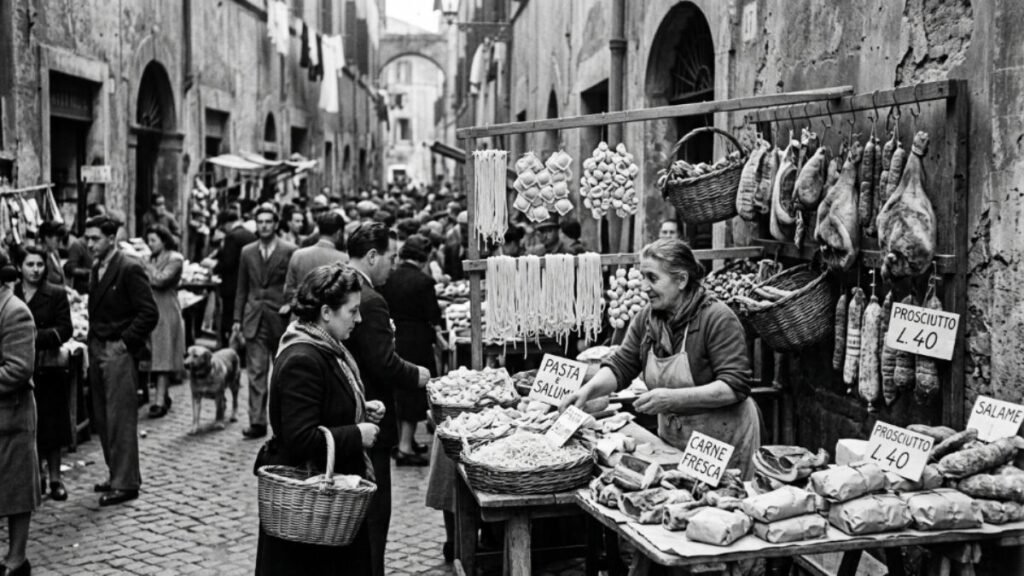
No single origin story for carbonara has ever been definitively proven, and this ambiguity is part of what makes the dish so fascinating. What food historians agree on is that carbonara as we know it today is a relatively modern creation — almost certainly originating in the mid-twentieth century — despite the romantic notion that it dates back centuries.
The Roman Coal Miner Theory
The most widely cited origin story connects carbonara to the carbonai, the charcoal workers of the Apennine mountains who traveled seasonally to Rome. According to this theory, the workers prepared a simple pasta with cured pork and eggs — ingredients that did not spoil easily — over open fires in the mountain camps. The name carbonara, derived from carbone (the Italian word for coal), is said to honor these workers, and some accounts mention that freshly ground black pepper was used so liberally it resembled coal dust falling over the pasta.
While this narrative is evocative, direct documentary evidence linking carbonara to the carbonai is thin. No cookbook from that era records this specific dish under this name in that context.
The World War II American Theory
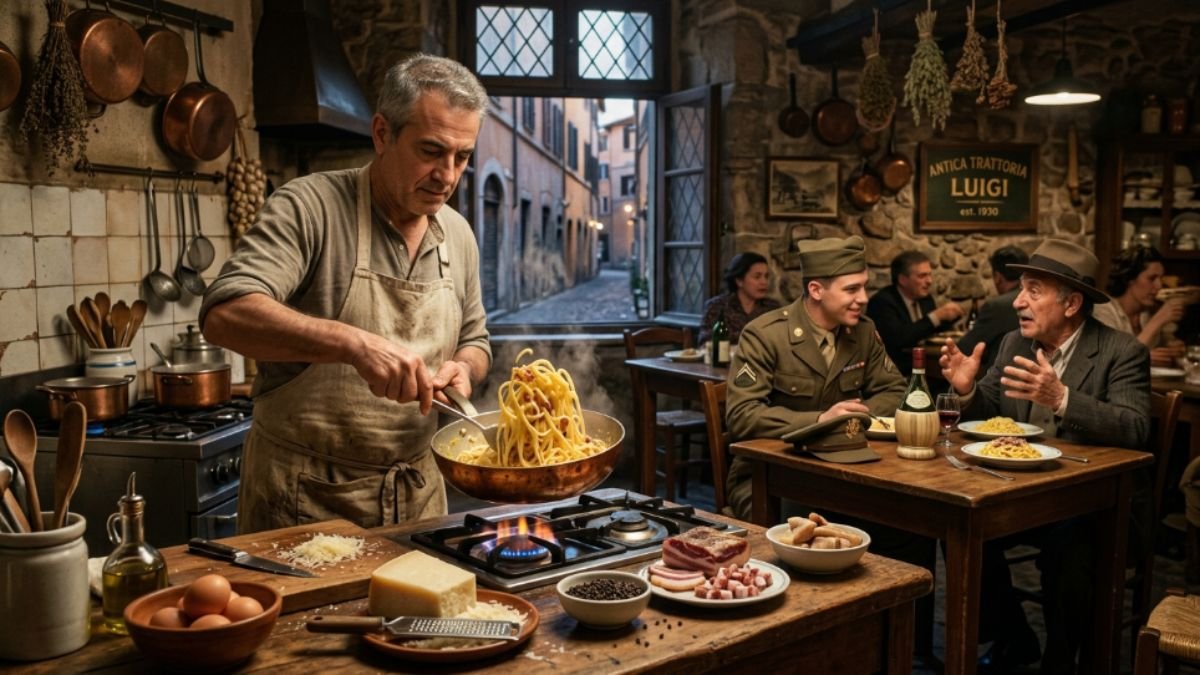
A second theory, and arguably the one with the most historical support, places the birth of carbonara in Rome during or just after World War II. American soldiers stationed in Italy had access to military rations that included powdered eggs and cured pork products, primarily bacon. The story holds that Roman cooks, resourceful as ever, combined these rations with local pasta and pecorino to create a dish that satisfied the soldiers and eventually entered the Roman culinary canon.
This would explain why carbonara emerged so clearly in the 1950s food record — cookbooks, restaurant menus, and newspaper articles from that decade begin referencing it consistently — but appears in no verifiable document from before the 1940s. The dish was born from scarcity, creativity, and a collision between American military supply chains and Roman culinary tradition.
The First Written Reference
The earliest known written reference to carbonara appears in a 1950 Italian newspaper, La Stampa, which describes it in connection with a Roman trattoria. By 1954, the first cookbook recipe had been published. From that point forward, the dish spread rapidly, both across Italy and into the American imagination — though the American version quickly diverged from the original in ways that Romans have been protesting ever since.
The Four Authentic Ingredients of a True Carbonara Recipe
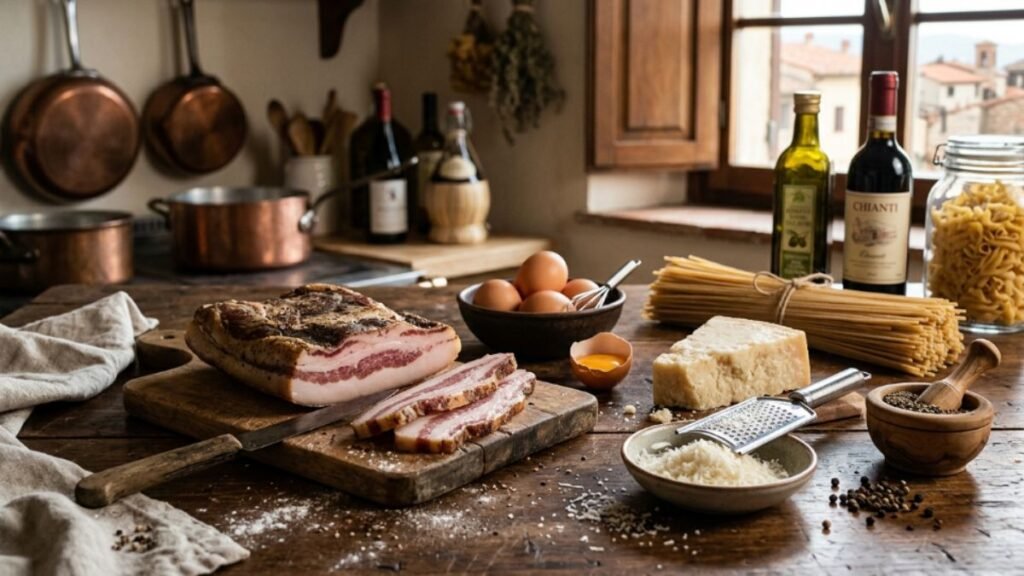
Authentic Roman carbonara is defined by exactly four ingredients plus pasta. Each one has a specific function, and substituting any of them changes the dish in ways that are more than cosmetic. This is not food snobbery — it is chemistry and flavor logic.
Guanciale: The Non-Negotiable Cured Pork
Guanciale is cured pork cheek, and it is the correct fat for carbonara. Its texture is distinct from pancetta or bacon: guanciale has a higher ratio of fat to meat, and that fat renders at a lower temperature into something glossy, sweet, and deeply savory. When you cut it into lardons and render it slowly in a pan, the fat that runs out becomes a sauce ingredient in its own right — coating the pasta before the egg mixture even arrives.
Pancetta is an acceptable substitute if guanciale is unavailable, though the flavor profile shifts. American bacon, which is smoked, introduces a smokiness that is foreign to the original dish and noticeably changes the end result. Most specialty Italian food retailers in the United States now carry guanciale, and it is worth seeking out.
Eggs and Egg Yolks: The Emulsification Engine
The sauce in an authentic carbonara recipe is made entirely from eggs — specifically a combination of whole eggs and extra yolks. The yolks contribute richness and color; the whole eggs provide structure and help the sauce emulsify with the pasta water. The ratio varies by cook, but a common standard is two yolks per serving, plus one whole egg per two servings.
The critical technical point is that the eggs are never scrambled. The residual heat of the pasta, combined with starchy pasta cooking water, gently cooks the egg proteins to a creamy, flowing consistency. Temperature management is everything. Too hot and the eggs curdle; too cold and the sauce will not form. This is the technique that intimidates beginners — and the one that rewards practice.
Pecorino Romano: The Salt and the Bite
Pecorino Romano is the traditional cheese for Roman carbonara, made from sheep’s milk and aged to a sharp, salty intensity. Many contemporary Roman chefs use a blend of Pecorino Romano and Parmigiano-Reggiano to balance the sharpness, but purists use Pecorino alone. In either case, the cheese must be freshly grated — pre-packaged powdered parmesan has neither the moisture content nor the melting properties needed to integrate into the sauce properly.
Black Pepper: Not a Garnish, but a Feature
Freshly ground black pepper in carbonara is not optional and not decorative. It is present in quantity, added both during cooking and at the finish, contributing a warmth and sharpness that cuts through the richness of the egg and guanciale fat. Use a coarse grind and do not be timid. Some interpretations of the carbonai origin story hold that the pepper was meant to resemble the coal dust on the workers’ hands — which, as culinary symbolism goes, is hard to top.
💡 Practical Tip: Bloom the black pepper for 30 seconds in the rendered guanciale fat before removing the pan from heat. This step extracts the fat-soluble compounds from the pepper and dramatically intensifies its flavor in the final dish.
The Great Cream Debate: Why Romans React the Way They Do
The addition of cream to carbonara is, to a Roman, roughly equivalent to putting ketchup on a steak. The reaction is not arbitrary gatekeeping — it reflects a genuine technical misunderstanding of how the dish works, and it produces a categorically different result.
Cream was likely introduced in the international versions of carbonara as a safeguard against the eggs curdling. If you add cream to the egg mixture, the emulsion is more forgiving because the fat content of the cream stabilizes the sauce even at higher temperatures. In other words, cream is training wheels. It makes the technique easier but masks the very quality that makes authentic carbonara extraordinary: the clean, clean richness of properly emulsified eggs and aged cheese.
A cream-based carbonara is a pasta in a heavy cream sauce. An egg-based carbonara — made correctly — is a pasta draped in something that feels lighter, silkier, and fundamentally more complex. Once you have tasted the authentic version, the cream shortcut is not just wrong; it is a lesser experience.
⚠️ Attention: The most common reason carbonara fails at home is heat. Remove the pasta from the stove entirely before adding the egg mixture, and use reserved pasta water — added one tablespoon at a time — to loosen the sauce without cooking the eggs past the point of no return.
How to Make an Authentic Carbonara Recipe: Step by Step
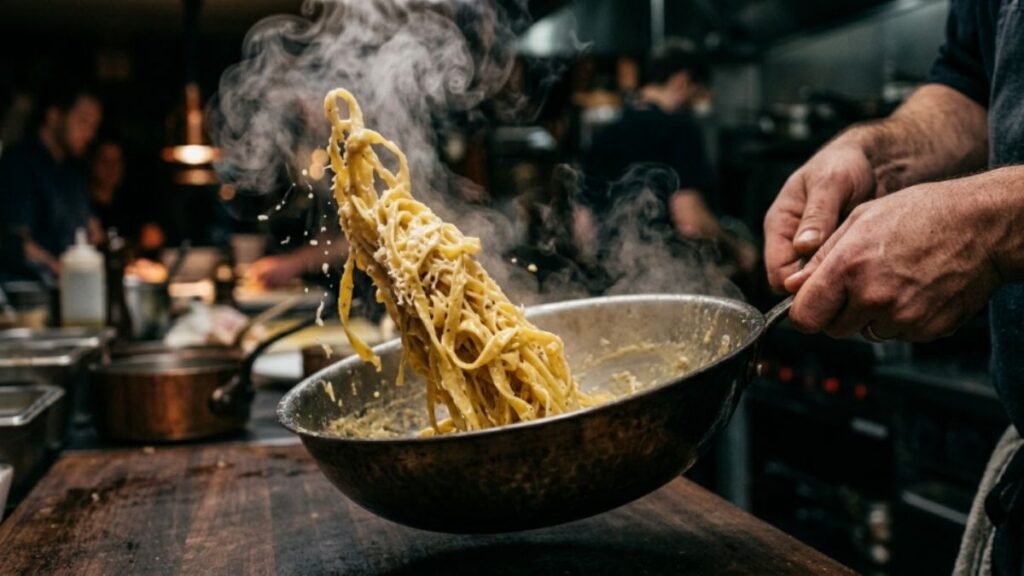
The following method reflects the traditional Roman approach, adapted for a home kitchen without a professional stove. It serves two people and takes approximately 25 minutes from start to finish.
Ingredients
- 200g spaghetti or rigatoni (spaghetti is traditional; rigatoni traps the sauce in its ridges)
- 100g guanciale, cut into 1/2-inch lardons
- 2 whole eggs plus 2 extra yolks, at room temperature
- 50g Pecorino Romano, freshly grated (plus extra for serving)
- 25g Parmigiano-Reggiano, freshly grated (optional, for balance)
- 1 teaspoon freshly ground black pepper, plus more to finish
- Kosher salt for pasta water — no salt in the sauce itself, as guanciale and Pecorino are very salty
The Method
- Bring a large pot of generously salted water to a full rolling boil. Use less water than you normally would — approximately 3 quarts — to produce starchier cooking water, which is essential for the sauce.
- While the water heats, render the guanciale in a cold pan over medium-low heat. Starting in a cold pan allows the fat to render slowly and evenly. Cook for 8 to 10 minutes until the edges are crispy and golden but the center pieces retain some chew. Add the black pepper and stir for 30 seconds. Remove the pan from heat.
- In a large mixing bowl, whisk together the eggs, egg yolks, grated Pecorino, and Parmigiano. The mixture should be thick and pale yellow. Set aside.
- Cook the pasta 1 minute less than the package directions for al dente. Before draining, reserve at least one full cup of pasta cooking water.
- Add the hot pasta directly to the pan with the guanciale and rendered fat. Toss vigorously over low heat for 30 seconds to coat every strand. Remove from heat entirely.
- Add the egg and cheese mixture to the pasta, tossing rapidly and continuously while adding pasta water one tablespoon at a time. The goal is a sauce that flows like thick cream and coats the pasta without any visible curds. This step typically takes 60 to 90 seconds of active tossing.
- Divide immediately between warm bowls. Finish with additional Pecorino and a generous grind of black pepper. Serve without delay — carbonara waits for no one.
✓ Best Practice: Warm your serving bowls with hot water and dry them just before plating. Carbonara cools quickly and a cold bowl accelerates the process. A warm bowl gives you an extra minute to get the texture right before serving.
Authentic vs. Common Variations: How They Stack Up
Understanding how different versions of carbonara compare helps clarify why ingredient choices matter. The table below covers the most commonly encountered versions in American kitchens and restaurants.
| Criterion | Authentic Roman | Cream Version | Bacon & Parmesan |
| Cured Pork | Guanciale | Pancetta or bacon | American smoked bacon |
| Sauce Base | Eggs + egg yolks only | Heavy cream + eggs | Eggs + cream |
| Cheese | Pecorino Romano | Parmesan | Parmesan only |
| Texture | Silky, flowing, light | Heavy, dense, sticky | Rich but one-dimensional |
| Difficulty | Technique-dependent | Forgiving | Easy |
| Flavor Profile | Complex, sharp, savory | Mild, sweet, heavy | Smoky, one-note |
| Italian Approval | Yes | No | No |
Common Mistakes That Ruin Carbonara (and How to Avoid Them)
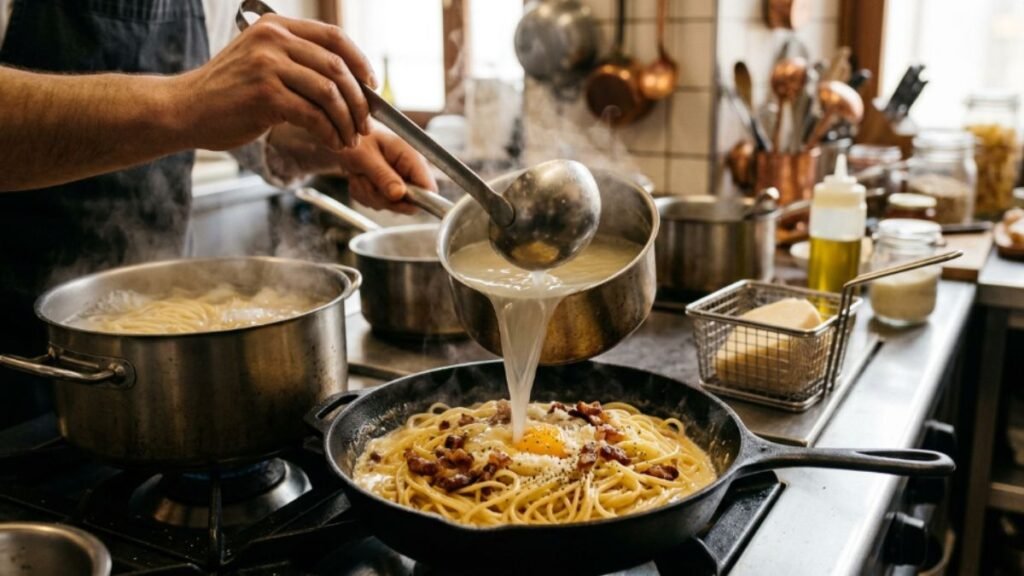
Carbonara is one of those dishes that looks simple in theory and punishes inattention mercilessly in practice. These are the five mistakes we observe most often, along with the direct fix for each.
Mistake 1: Adding the Eggs Over Direct Heat
This is by far the most common error, and it turns carbonara into a bowl of scrambled eggs over pasta. The egg proteins cook at approximately 145 degrees Fahrenheit. A pan that just cooked pasta is far hotter than that. The solution is to remove the pan from all heat sources before adding the egg mixture and to work fast, using pasta water as a temperature moderator.
Mistake 2: Using Cold Eggs
Cold eggs from the refrigerator are more prone to curdling because they create an abrupt temperature shock when they hit the hot pasta. Let your eggs come to room temperature for 20 to 30 minutes before you begin cooking. This small adjustment noticeably smooths the emulsification process.
Mistake 3: Not Reserving Enough Pasta Water
Pasta cooking water is the secret ingredient in carbonara, and it serves two functions: it loosens the sauce to the right consistency, and the dissolved starch helps the egg and cheese emulsify into something cohesive. Reserve at least one full cup. You may not use all of it, but running out mid-toss is a recipe for a clumped, broken sauce.
Mistake 4: Using Pre-Grated Cheese
The anti-caking agents in pre-packaged grated cheese prevent it from melting and integrating smoothly. Always grate Pecorino Romano and Parmigiano fresh, using the fine side of a box grater. The texture should be almost powdery, not stringy.
Mistake 5: Letting It Sit
Carbonara is a dish that belongs on the table immediately. Every minute it rests, the egg proteins continue to cook from residual heat and the sauce tightens. Prepare all your components in advance, have your bowls warm, and move from pan to bowl to table without delay.
Carbonara in American Food Culture: Adaptations and Influences
The Americanization of carbonara followed a familiar path: the most technically demanding element — the egg emulsification — was replaced with the most forgiving one — cream. Italian-American restaurants in the 1960s and 1970s standardized a cream-based version that was consistent, easy to batch-produce, and accessible to palates unaccustomed to the intensity of Pecorino Romano.
This version became so dominant that for many Americans, it is simply what carbonara means. The authentic recipe, when encountered, sometimes reads as strange — too intense, too sharp, too different from what they expect. This is not a failure of taste; it is a failure of context. Italian food in America was filtered through the needs of a restaurant industry that prioritized consistency over technique.
The good news is that access to authentic ingredients has never been better. Guanciale is carried by most specialty Italian delis and is available online through several importers. Pecorino Romano is stocked by virtually every major grocery chain. The tools needed to make a proper carbonara recipe at home are now within reach for most American home cooks who want to explore the real thing.
Carbonara is only one chapter in a much longer story. Roman pasta tradition alone includes cacio e pepe, amatriciana, and gricia — all built on the same philosophy of restraint and technique. Our authentic Italian pasta recipes guide covers the full canon, region by region.
Where to Eat Authentic Carbonara in Rome
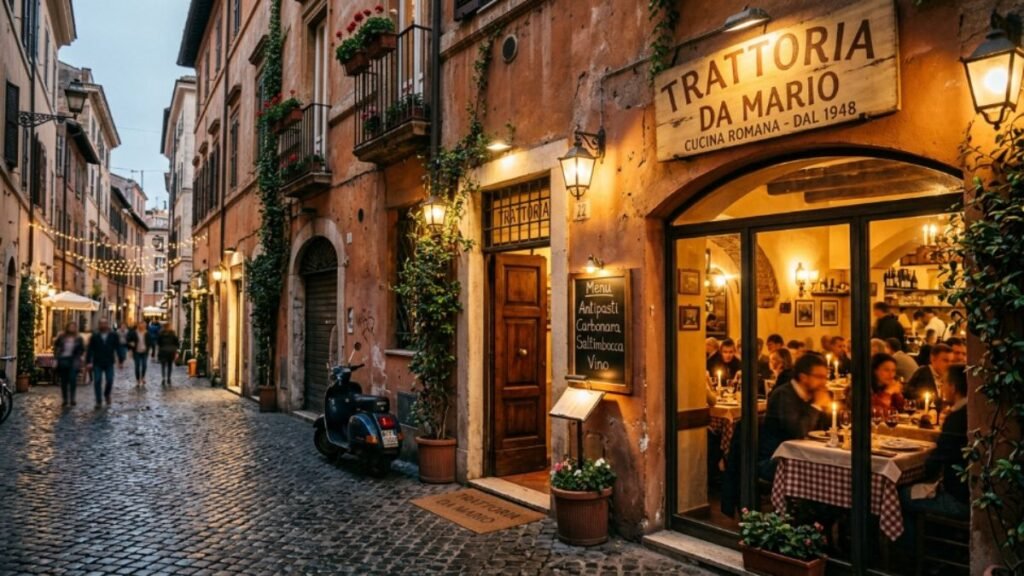
If you find yourself in Rome and want to eat carbonara where it is made the way it has always been made, a few institutions stand out. Roscioli, in the Jewish Ghetto neighborhood, is frequently cited by food critics and locals alike as the benchmark for Roman carbonara. Da Enzo al 29 in Trastevere represents the more rustic, neighborhood-trattoria tradition. Armando al Pantheon, steps from the Pantheon, has served an unchanged menu of Roman classics for decades.
What these places share is adherence to the four-ingredient canon: guanciale, eggs, Pecorino Romano, black pepper. No cream appears on any of their menus in any context associated with this dish. Ordering carbonara in Rome is an act of trust — trust that the kitchen knows exactly what it is doing and that the version you are about to eat has been refined over generations.
For Americans planning a food-focused trip to Italy, adding a carbonara benchmark dinner to the itinerary is one of the most rewarding culinary experiences available. It resets your understanding of what a few simple ingredients, handled correctly, can produce.
A food trip through Italy rarely stops at one city. If your itinerary extends north to Tuscany, our guide to the best gelaterias in Florence maps the most essential stops for anyone serious about eating well on the road.
Final Thoughts
Carbonara is, at its core, a lesson in restraint and technique. Its history — whether it traces back to charcoal workers in the Apennines or American soldiers in post-war Rome — is a story about how great food emerges from constraint and ingenuity. Its recipe is a reminder that complexity of flavor does not require complexity of ingredients.
The key takeaways from everything we have covered here are straightforward: use guanciale, use real Pecorino Romano, use only eggs, manage your heat, and move quickly. Avoid cream not because of tradition for its own sake, but because the authentic version is simply better — cleaner, more nuanced, and more satisfying.
Make the carbonara recipe once with authentic ingredients and the proper technique, and you will understand immediately why Romans are so protective of it. Then make it again. It rewards repetition, and each time the sauce comes together — silky, coating every strand of pasta, just the right side of runny — it feels like a small triumph. That is exactly what it is.
Tried this recipe? Leave a comment below and let us know how it turned out. Carbonara has a way of becoming a household obsession, and we would love to hear about your first authentic attempt.
Frequently Asked Questions about The History Behind Carbonara
Can I use bacon instead of guanciale in a carbonara recipe?
You can use bacon as a substitute, but it will produce a noticeably different result. American bacon is smoked, which introduces a smokiness that is not part of the authentic Roman flavor profile. Pancetta is the closest widely available alternative — it is unsmoked cured pork belly with a fat content closer to guanciale. If you can find guanciale at a specialty Italian market or online, it is worth the effort for the genuine experience.
Why does my carbonara turn into scrambled eggs?
This happens when the egg mixture hits a pan that is too hot. Remove the pan entirely from all heat before adding the eggs, and work quickly while tossing continuously. Adding pasta cooking water one tablespoon at a time helps cool the pan gradually and prevents the proteins from seizing. Eggs at room temperature (not straight from the refrigerator) also emulsify more reliably and are less prone to curdling on contact with hot pasta.
How many calories are in a carbonara recipe serving?
A single serving of authentic carbonara made with 100g of dry pasta, 50g of guanciale, two eggs plus yolks, and 50g of Pecorino contains approximately 700 to 800 calories, depending on the specific proportions used. The caloric density comes primarily from the guanciale fat and egg yolks. Carbonara is not a light dish, but it is one made from whole, recognizable ingredients without additives or processed components.
What pasta shape is best for carbonara?
Spaghetti is the most traditional shape and the one you will find in Roman trattorias. Rigatoni is a popular and legitimate alternative — the ridges and hollow center trap the sauce inside each piece, which produces an intensely flavored bite. Tonnarelli, a square-cut thick spaghetti traditional to Rome, is another excellent option if you can find it. Avoid short, smooth pasta like penne without ridges, which does not hold the sauce as effectively.
Can carbonara be made ahead of time?
Carbonara does not hold or reheat well and is genuinely best made and eaten immediately. The egg sauce continues to cook from residual heat as it sits and tightens considerably within minutes of plating. If you need to manage timing, prepare all components in advance — grate the cheese, render the guanciale, whisk the egg mixture — and cook the pasta and assemble just before serving. The full cooking process takes under 30 minutes once everything is prepped.
Is there a vegetarian version of carbonara?
There is no vegetarian version of carbonara that is considered authentic, since guanciale is central to the dish’s flavor and texture. That said, a number of vegetarian cooks have developed variations using smoked mushrooms or roasted cauliflower as a substitute for the guanciale fat and savory depth. These are interesting dishes in their own right but should be understood as inspired adaptations rather than carbonara. The name belongs to the original four-ingredient formula.
What wine pairs well with carbonara?
The classic Roman pairing is a crisp, dry white wine from the Lazio region — specifically Frascati or a Frascati Superiore. The acidity cuts through the richness of the egg and fat, and the mineral notes complement the sharpness of Pecorino Romano. If you prefer red wine, a light-bodied option such as a young Cesanese del Piglio from the same region works well. Avoid full, tannic reds, which clash with the delicate egg sauce.

Mary Ciss is a food writer and Italian gastronomy enthusiast with a passion for authentic recipes, culinary history, and the stories behind every dish. Through Mio Gelatto, she explores the real flavors of Italy — from centuries-old gelato traditions to the hidden trattorias that locals love. For Mary, every recipe is a journey.