The Gelato Route: Best Gelaterias in Italy and How to Visit Them
Italy has an estimated 36,000 gelaterias — but finding the best gelaterias in Italy takes more than luck. Most of them are not worth your time.
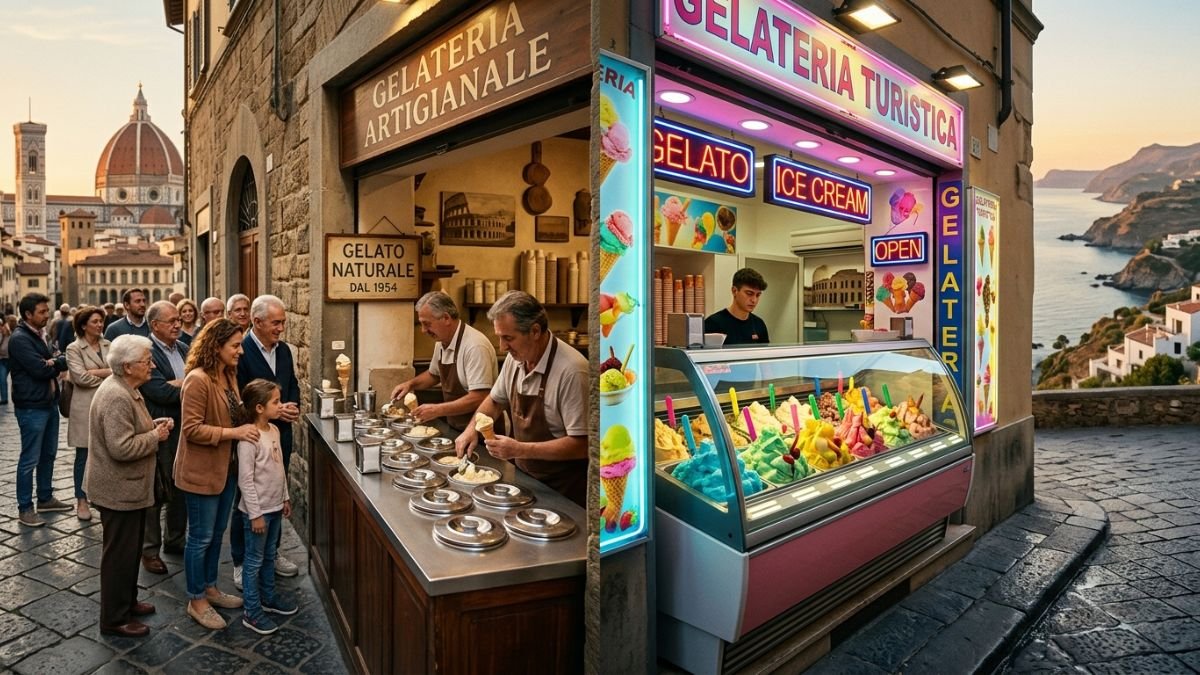
That is not cynicism — it is context. The gelato industry in Italy generates over 3 billion euros annually, and where there is money, there are shortcuts. Walk within a hundred metres of the Trevi Fountain or the Uffizi Gallery and you will pass no fewer than a dozen shops piling lurid mounds of artificially coloured gelato into the window, designed to photograph beautifully and taste of almost nothing.
We have spent considerable time eating our way through the best gelaterias in Italy — from neighbourhood spots in Bologna that do not appear in any guidebook, to legendary institutions in Florence that have been making gelato for nearly a century. What we have found is that finding authentic artisan gelato is less about luck and more about knowing exactly what to look for.
This guide gives you a city-by-city breakdown of Italy’s finest gelaterias, the practical tools to tell the real thing from the imitation, and everything you need to plan a food-focused visit — whether you are going to Florence for a weekend or building a full Italian gastronomic itinerary.
How to Recognise Authentic Artisan Gelato Before You Order
The single most useful thing you can do before visiting any gelateria in Italy is learn to read the physical space. Authentic gelato artigianale communicates its quality through very specific visual cues — and once you know them, they are impossible to unsee.
The pozzetti rule
Genuine artisan gelato is stored in flat, covered metal containers called pozzetti, set flush with the counter with lids on top. This protects the gelato from light, air, and temperature fluctuation. If the gelato is displayed in open, towering mounds — regardless of how photogenic they look — it is almost certainly industrial or semi-industrial product. The piles you see online have been engineered for Instagram, not for flavour.
Colour is your most reliable signal
Pistachio gelato made from real Bronte pistachios is a muted, greyish-green. Banana gelato made from actual bananas is a pale, almost beige-yellow. Mint gelato is white or very faintly green. Anything neon, fluorescent, or unnaturally vivid contains artificial colouring. This rule holds without exception for the best gelaterias in Italy.
The signage tells you what you need to know
Look for the phrases artigianale or produzione propria (made in-house). These are not marketing terms in Italy — they carry a specific meaning and a gelateria that uses them takes responsibility for that claim. The absence of these words on the signage is telling.
Practical Tip: Ask for a sample on a flat wooden spoon (una piccola assaggio) before committing to a scoop. Any reputable gelateria will oblige without hesitation. If they refuse, walk away.
Authentic vs. Industrial Gelato: A Quick Reference
Indicator | Artisan Gelateria | Industrial / Tourist Trap |
Storage | Covered pozzetti, flat containers | Open mounds piled high |
Colour | Natural, muted tones | Bright, vivid, artificial |
Signage | Artigianale / produzione propria | Generic or no claims |
Flavour list | Seasonal, changes regularly | Fixed year-round, 40+ flavours |
Location | Neighbourhood streets, local areas | Within 100m of major landmarks |
Florence: Home to Some of the Best Gelaterias in Italy
Florence’s claim to the gelato tradition runs deep. Bernardo Buontalenti, a Florentine polymath working under the patronage of the Medici court, is widely credited with creating one of the earliest documented versions of gelato in the 16th century. The city has never stopped taking this heritage seriously, and today it remains home to some of the finest artisan gelaterias in the world.
Gelateria dei Neri
Tucked in the Santo Spirito neighbourhood, Gelateria dei Neri has cultivated a ferociously loyal local following over several decades. The pistachio — made with nuts sourced directly from Bronte in eastern Sicily — is among the most discussed in Florence. The space is small, the staff are efficient rather than effusive, and summer queues can stretch well down the street. All reliable indicators.
Gelateria Vivoli
Established in 1930, Vivoli is widely considered the oldest operating gelateria in Florence and one of the oldest in Italy. A notable point of distinction: they serve gelato only in cups, never in cones — a deliberate philosophical stance that says everything about how seriously they take the product. The riso (rice) flavour, a house classic, is something you will not find replicated with any real success elsewhere in the city.
Badiani — Buontalenti Flavour
Badiani’s Buontalenti is a closely guarded recipe named after the Medici court inventor himself — a rich, custard-like blend of eggs, cream, and Marsala wine that produces a flavour unlike anything else you will encounter on the gelato route. The Viale dei Mille location, away from the tourist centre, is where serious visitors go.
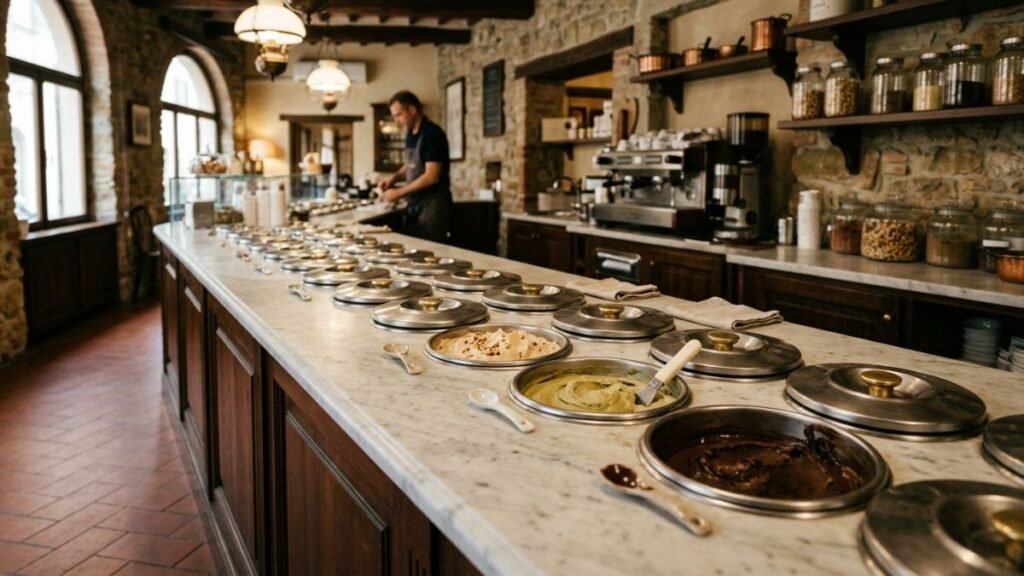
Best Practice: In Florence, prioritise gelaterias in the Oltrarno and Santa Croce neighbourhoods. These areas serve a predominantly local clientele, which tends to self-regulate quality far more effectively than tourist zones.
Prefer to explore with a local guide? A gastronomic walking tour of Florence will take you to the best gelaterias alongside olive oil producers, mercato stalls, and historic food shops:
Rome: Finding Authentic Gelato in the Most Imitated City
Rome receives more than 30 million tourists per year, and its historic centre has responded to that volume in the way most tourist centres do: with a proliferation of venues optimised for footfall rather than food quality. This makes Rome simultaneously the most disappointing and most rewarding city for gelato — disappointing if you do not know where to look, extraordinary if you do.
Fatamorgana
Founded by Maria Agnese Spagnuolo, Fatamorgana operates on a philosophy of radical flavour experimentation and total gluten-free production. The combinations — walnut and basil, Gorgonzola with fig honey, avocado with lime — sound conceptual but taste meticulously considered. It has attracted coverage in publications from the New York Times to the Guardian, and it deserves every word of it.
Gelateria del Teatro
Located a short walk from Piazza Navona, Gelateria del Teatro distinguishes itself through its use of botanicals and herbs alongside seasonal fruit. The sage and black cherry combination is cited by food writers as among the finest single-spoonful experiences in the city. Arrive in the morning for the widest selection and shortest queues.
Important: In Rome, avoid any gelateria visible from the Colosseum, the Trevi Fountain, or the Vatican entrance. Proximity to major monuments correlates almost perfectly with low-quality, high-priced product. Walk three streets away from any landmark and quality improves immediately.
Explore Trastevere or Testaccio with a food guide who knows both the history and the hidden stops:
You might like to know – Why Ice Cream Tastes So Good: The Science Behind Ice Cream Pleasure
Bologna: The World Capital of Gelato Culture
Bologna is known across Italy as La Grassa — the fat one — and the city has earned that reputation through centuries of cooking that prioritises quality above almost everything else. It is also home to the Carpigiani Gelato Museum and the internationally recognised Gelato University, both of which have positioned Bologna as the theoretical and educational centre of gelato production worldwide.
Cremeria Funivia
Cremeria Funivia operates on a strictly seasonal menu that reflects whatever is at peak ripeness in the local food market. A visit in May will taste entirely different from one in October — intentionally. This commitment to the agricultural calendar is rare even among Italy’s best artisan producers, and the results are extraordinary. It has appeared on best-of lists compiled by Italian food critics, international travel publications, and gelato professionals trained at the Gelato University.
Carpigiani Gelato Museum, Anzola dell’Emilia
Technically just outside Bologna, the Carpigiani Gelato Museum is an essential stop for anyone serious about understanding what makes Italian gelato distinct. The museum traces the full history of the product from its Arab and Medici-era origins through to contemporary artisan production, with tasting sessions that contextualise everything in your cup. Entry costs around 12 euros and includes a gelato tasting.

Sicily: The Ancient Roots of Italian Frozen Desserts
Sicily’s relationship with frozen desserts predates the Italian mainland by several centuries. Arab traders who governed the island between the 9th and 11th centuries brought with them the practice of combining snow from Mount Etna with fruit syrups, flower essences, and spices — a direct ancestor of what we now call gelato. Sicilian frozen desserts have their own distinct character: bolder, denser, and more intensely flavoured than northern versions, shaped by the quality of local pistachios, almonds, citrus, and stone fruit.
Gelateria Stancampiano, Palermo
The Stancampiano family has been producing gelato in Palermo since 1952. Their Bronte pistachio — made exclusively with nuts from the Etna foothills, where volcanic soil produces pistachios of remarkable intensity — is cited by multiple food writers as the finest pistachio gelato available anywhere in Sicily. In a region where pistachio gelato is a point of fierce local pride, that is significant.
Bam Bar, Taormina — and the Granita Tradition
Bam Bar sits above the Ionian Sea in Taormina and is best known not for gelato but for granita — Sicily’s version of the frozen dessert, coarser in texture and more crystalline than gelato, with an intensity of fruit flavour that has no equivalent. The mulberry granita served inside a brioche bun — the traditional Sicilian colazione — is one of the most specifically Sicilian food experiences available to a visitor.
Sicily’s street food and dessert culture is best experienced with a local:
Practical Tips for Building Your Gelato Route
Eating your way through the best gelaterias in Italy is not difficult, but a few practical habits will improve every visit significantly.
- Go in the morning. Gelato is made fresh daily, and morning batches are at their peak before the heat of the afternoon and the cumulative effect of traffic affect the texture.
- Order one flavour first. A single scoop tells you everything about quality. If the first flavour is outstanding, you can always return — ideally the same day.
- Always ask for a sample. The practice is universal at reputable establishments. If a gelateria declines a sample request, treat it as a red flag.
- Eat it immediately and standing up. This is how Italians eat gelato. It is not designed to survive a walk of more than a few minutes, and eating it at a table while distracted means you are not giving it the attention it deserves.
- Keep a short list. A note on your phone of standout gelaterias, specific flavours, and prices helps enormously when planning which stops to revisit before you leave.
Guided Gelato Experiences Worth Booking
For travellers who want to go beyond a list of addresses, a guided gelato tour or a hands-on gelato making class delivers something a map cannot: the context, the stories, and the inside knowledge that turns a collection of gelato shops into a coherent culinary narrative.
- Florence Gelato Making Class — learn from a working gelatiere in a professional kitchen, including the science of the base custard and how to adjust textures and flavours
- Rome Gelato and Dessert Walking Tour — a curated walk through the best artisan spots in Rome’s centro storico with a bilingual food guide
- Bologna Food Culture Tour — combines gelato tastings with visits to the Quadrilatero market and historic salumerie
The Gelato Route is Worth Every Step
The best gelaterias in Italy share a quality that has nothing to do with fame or footfall: they take the product seriously. They source carefully, change seasonally, refuse to cut corners, and produce something that is recognisably different from what you find everywhere else.
The gelato route — from Florence’s historic institutions to Bologna’s seasonal experimenters to Sicily’s ancient frozen dessert tradition — is not a tourist itinerary. It is an education in what happens when food is made with genuine care and genuine ingredients.
If this guide helps you find even one scoop that you will remember for years, it has done its job. Bookmark it before your next trip and let us know in the comments which gelateria made the biggest impression.
Frequently Asked Questions about Best Gelaterias in Italy
What is the difference between artisan gelato and regular ice cream?
Artisan gelato contains significantly less fat and air than ice cream, which results in a denser texture and more concentrated flavour. It is also served at a warmer temperature — around -11°C compared to -18°C for ice cream — which keeps it soft and pliable. The key distinction for a visitor to Italy is that artisan gelato (gelato artigianale) is made fresh daily on-site in small batches, using real ingredients rather than industrial powders or bases.
How much does gelato cost in Italy?
At an authentic artisan gelateria, expect to pay between 2.50 and 4 euros for a single scoop (one flavour in a small cup or cone), and between 3.50 and 5 euros for a double scoop. Prices above this range near tourist landmarks are generally not correlated with higher quality — they reflect location rather than product. A gelateria charging 7 or 8 euros per scoop in the shadow of the Colosseum is selling you the view, not the gelato.
What are the best gelato flavours to try in Italy?
The safest test of any gelateria is to order a classic flavour where imitation is immediately obvious: pistachio, hazelnut (nocciola), or dark chocolate (cioccolato fondente). Regional specialities are worth prioritising: Bronte pistachio in Sicily, rice gelato (riso) in Florence, and the house flavour at any gelateria with its own named signature.
Is it better to book a gelato tour or explore independently?
Both approaches have merit, but for first-time visitors to a city, a guided tour of 2 to 3 hours provides context and local knowledge that is difficult to replicate independently. A good guide will explain the production process, the regional differences between gelato styles, and the cultural significance of specific traditions — information that makes the independent exploration you do afterwards far more rewarding. Guided tours in Florence and Rome typically cost between 45 and 75 euros per person and include multiple tastings.
Which Italian city has the best gelato?
Bologna has the strongest argument on institutional and cultural grounds — it is home to Gelato University, the Carpigiani Museum, and a food culture that has driven consistent quality for generations. Florence has the deepest historical claim and several of the most respected individual gelaterias in the world. Sicily offers the most distinctive regional character. In practice, the gap between cities at the artisan level is narrow — the gap between an artisan gelateria and a tourist trap within the same city is far wider.
Can I find good gelato in Italy year-round, or only in summer?
Artisan gelaterias operate year-round, and winter is actually a rewarding time to visit — queues are shorter, staff have more time to talk, and winter-specific flavours (persimmon, chestnut, blood orange) are often more interesting than summer classics. The perception of gelato as a summer product is a tourist phenomenon. Italians eat it in every season, often standing at the counter in a winter coat without any apparent discomfort.